
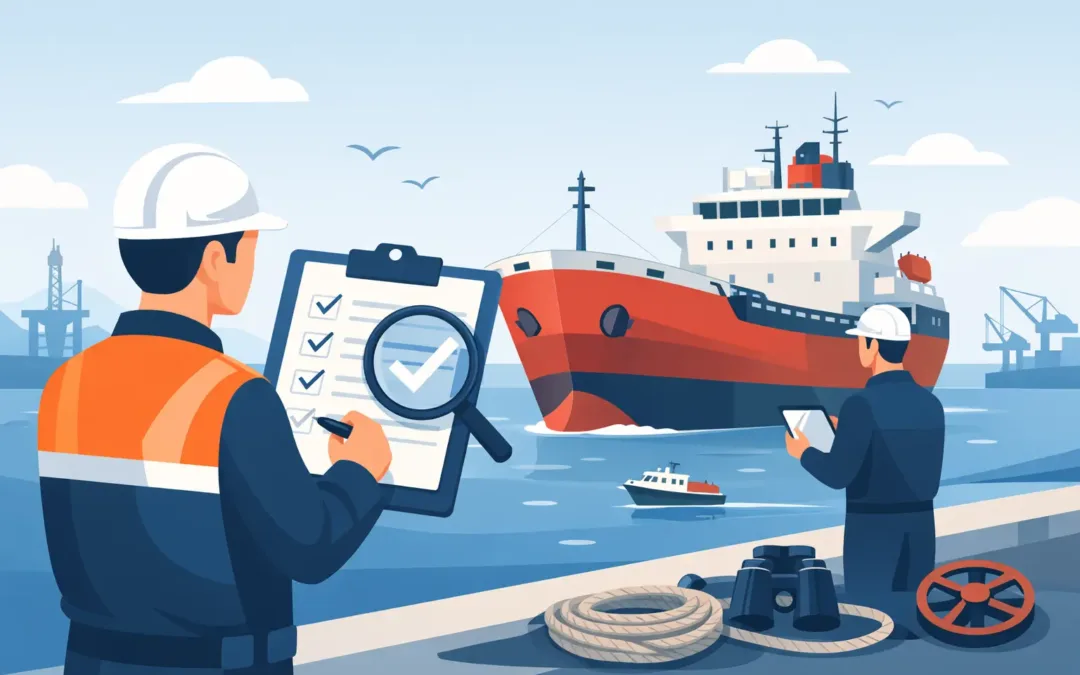
A vessel can be classed, certified, and trading without being ready for a demanding charterer or terminal review. A vessel pre vetting inspection provides an independent, operational assessment before a formal vetting process exposes deficiencies that may lead to rejection, restrictions, off-hire exposure, or costly corrective action under time pressure.
For owners, operators, managers, and chartering teams, the purpose is not to produce a favorable-looking report. It is to identify the condition, procedural, maintenance, and documentary issues that a vetting inspector is likely to test – then establish a credible close-out path before the vessel is nominated.
What a Vessel Pre Vetting Inspection Is Designed to Prove
Pre-vetting is a readiness assessment. It examines whether the vessel can demonstrate safe operation in practice, not merely whether certificates are valid. The inspection considers the physical condition of the ship, the effectiveness of onboard management systems, crew familiarity with critical procedures, and the quality of records supporting those procedures.
Formal vetting regimes vary by charterer, cargo interest, terminal, oil major, and vessel trade. A tanker subject to SIRE expectations will face a different review environment than a dry bulk carrier, offshore support vessel, or general cargo ship. The principle remains consistent: the vessel must be able to show that its controls work at the time of inspection.
A pre-vetting inspection therefore gives the operator an informed view of likely observations before an external inspector, terminal representative, or chartering department makes its own determination. It is particularly valuable before a first call at a sensitive terminal, a change of trade, a new management assignment, reactivation after layup, or a high-value fixture.
Pre-Vetting Is Not a Statutory or Class Survey
A common error is to treat current statutory certificates, class status, and port state control history as proof of vetting readiness. These records matter, but they do not answer every vetting question.
Class verifies compliance with applicable rules and survey requirements. Flag-state certification addresses statutory obligations. Port state control identifies enforceable deficiencies against international conventions and local requirements. Vetting, however, is a commercial risk-screening process. It may examine standards beyond the minimum legal threshold and may place substantial weight on maintenance culture, crew competence, operational discipline, and the condition of equipment on the inspection day.
For example, a fire door may be technically serviceable but poorly maintained, improperly secured, or unsupported by clear inspection records. A cargo operation procedure may be available onboard but not understood by the officer responsible for executing it. Either condition can weaken confidence in the vessel’s safety management and create a preventable observation.
Scope of a Vessel Pre Vetting Inspection
The inspection scope should reflect the vessel type, cargoes, intended trade, customer requirements, and available preparation time. A focused review may be appropriate when a vessel is approaching a specific terminal acceptance inspection. A broader assessment is warranted when management wants a full readiness baseline.
An effective pre-vetting inspection commonly addresses the following operational areas:
- Hull, deck, accommodation, engine room, and safety-critical equipment condition
- Navigation, bridge resource management, passage planning, and chart or publication control
- Firefighting, lifesaving, emergency preparedness, and crew drill performance
- Cargo systems, pollution prevention equipment, tank or hold condition, and transfer procedures
- Planned maintenance, defect reporting, work permits, risk assessments, and corrective-action records
- Safety management documentation, training evidence, certification control, and crew familiarity with shipboard procedures
The value is in connecting these items rather than reviewing them as isolated checkboxes. A missing maintenance record may be a paperwork lapse, but it may also indicate that testing was not completed. An overdue corrective action may point to weak shore-side follow-up. In a vetting setting, patterns carry more weight than an individual untidy record.
Physical Condition and Housekeeping
First impressions are not superficial in vessel vetting. Corrosion, leaks, unsecured equipment, poor lighting, faded safety markings, blocked access routes, and inadequate housekeeping can indicate wider control weaknesses. The inspection should identify visible deficiencies while distinguishing between cosmetic matters and conditions that affect safety, operability, or asset integrity.
Particular attention should be given to watertight and weathertight integrity, guardrails, walkways, mooring equipment, machinery space condition, emergency escape routes, fire doors, ventilation closures, and signage. Where hatch covers are relevant, ultrasonic hatch cover testing or a targeted weathertightness assessment may provide objective evidence beyond a visual review.
Operational Readiness and Crew Familiarity
Vetting inspectors frequently test whether officers and crew can explain the procedures they are expected to follow. The relevant question is not whether a manual exists, but whether personnel can apply it during a cargo operation, emergency, bunkering event, enclosed-space entry, or navigation challenge.
Interviews should be conducted with the master, chief officer, chief engineer, deck officers, engineers, and ratings where appropriate. Responses should be compared with the vessel’s documented procedures and recent records. Inconsistent answers do not automatically mean the vessel is unsafe, but they show that familiarization, supervision, or onboard communication may require attention.
Drills deserve similar scrutiny. A completed drill form has limited value if assigned personnel cannot locate equipment, describe their duties, or demonstrate communications. A practical pre-vetting review may include selected demonstrations, particularly for emergency steering, fire response, oil spill prevention, enclosed-space rescue, and cargo-related emergencies.
Records That Withstand Inspection
Documentation is often where an otherwise well-maintained vessel loses credibility. Logbooks, planned maintenance entries, certificates, risk assessments, permit-to-work records, drill reports, safety meeting minutes, and corrective-action registers should be current, internally consistent, and available without delay.
The concern is not administrative perfection for its own sake. Records are evidence that shipboard controls are operating. If an equipment test is recorded but related defects remain open, the inspector may question the effectiveness of the test. If risk assessments are generic and repeatedly copied, they may not demonstrate that the crew evaluated the actual work being performed.
Before formal vetting, the vessel should review open defects, overdue maintenance, expired or near-expiry certificates, incomplete close-out actions, and discrepancies between hard-copy and electronic records. Altering records to create an appearance of compliance is never an acceptable remedy. Deficiencies must be corrected, accurately documented, and, where necessary, transparently managed with the relevant stakeholders.
Turning Findings Into a Credible Close-Out Plan
The inspection report should prioritize findings by operational consequence. A missing label and a defective emergency pump do not carry the same risk, and neither should receive the same response. Clear categorization helps management allocate resources where they will protect safety and commercial acceptance most effectively.
Each finding should identify the condition observed, the applicable requirement or operational expectation, the risk created, the responsible party, and a realistic due date. Photographs, equipment references, record excerpts, and interview observations strengthen the report and make close-out verification more efficient.
Some issues can be corrected immediately onboard: replacing damaged signage, removing obstructions, updating controlled documents, or completing overdue familiarization. Others require shore support, spare parts, class attendance, dry-docking work, or a revision to fleet procedures. A sound pre-vetting process separates immediate housekeeping from issues that require technical planning and avoids representing temporary measures as permanent repairs.
Reinspection is useful when material observations were found, particularly those involving safety-critical equipment, cargo containment, fire protection, navigation, or recurring management-system failures. Remote document review can support progress monitoring, but it is not always sufficient to verify a physical repair or crew performance issue.
When Independent Inspection Adds Value
Internal audits are essential, yet an independent surveyor can identify normalization of deviance – conditions the crew or management team has gradually come to accept because the vessel trades with them every day. Independent inspection also provides objective documentation when owners, technical managers, charterers, insurers, or financing parties need a clear condition assessment.
This is especially relevant for vessels operating on short notice through Gulf Coast ports, where nomination and terminal scheduling can leave little time for corrective work. An early, disciplined review gives the operator more choices: repair before arrival, arrange attendance at the next suitable port, provide supporting evidence to the charterer, or reconsider a nomination before commercial commitments become difficult to unwind.
Zeus Marine and Cargo Solutions LLC provides independent pre-vetting inspections that connect vessel condition, operational practice, and documentary evidence into an actionable readiness assessment. The objective is direct: identify exposure early enough for the vessel team and shore management to correct it properly.
A well-executed pre-vetting inspection should leave the vessel with more than a list of defects. It should give the master and management team a practical record of what must be corrected, what must be demonstrated, and what evidence will support confident charter and terminal review.
