
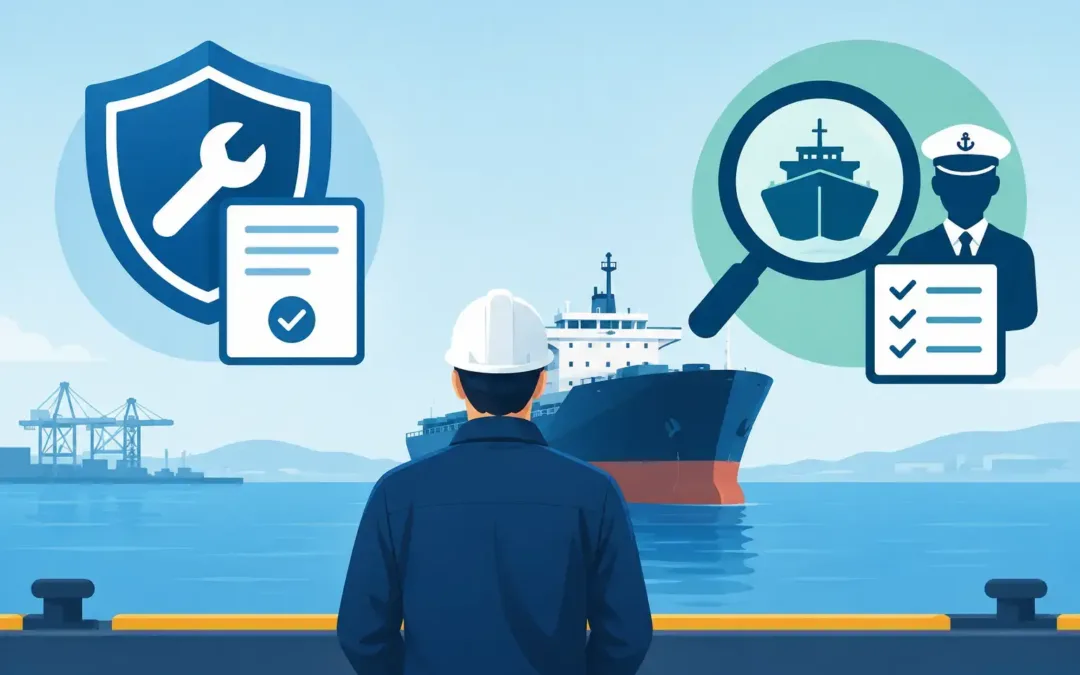
A vessel may satisfy a charterer’s screening requirements and still be unsuitable for a specific heavy-lift, towage, or offshore installation operation. The reverse can also be true: a marine warranty surveyor may approve a defined project plan while an operator rejects the vessel for commercial, safety-management, or terminal-access reasons. That distinction is the center of warranty versus vetting in marine operations.
Both services manage risk, but they answer different questions, rely on different evidence, and carry different consequences. Treating one as a substitute for the other can create avoidable exposure at the fixture stage, before a critical loadout, or when an underwriter examines a casualty.
Warranty Versus Vetting: The Core Difference
Marine warranty surveying is project-specific independent assurance. A marine warranty surveyor, commonly appointed for insurers, lenders, developers, or project principals, reviews whether a defined marine operation can proceed within stated criteria. The work may cover transportation, loadout, towage, lifting, installation, float-on/float-off activity, or other high-consequence operations. The deliverable is often a certificate of approval, letter of approval, or documented recommendation tied to approved procedures and limiting conditions.
Vetting is an acceptance process focused primarily on the vessel, its operator, and its operating record. Charterers, cargo interests, terminals, energy companies, and ship managers use vetting to decide whether a vessel is an acceptable counterparty for a trade, cargo, terminal, or contract. It reviews condition, certification, management systems, crew competence, inspection history, incident performance, and operational suitability.
Put simply, marine warranty asks, “Is this planned operation adequately engineered, controlled, and ready to proceed?” Vetting asks, “Is this vessel and operator acceptable for the intended employment?” The first is anchored to a particular operation. The second is anchored to continuing vessel and management risk.
What a Marine Warranty Surveyor Examines
The scope of a marine warranty survey is governed by the project, underwriting requirements, contract terms, and applicable codes or recognized industry guidance. It is not a generic vessel inspection. A sound scope identifies the operational phases that require review and establishes the conditions under which approval may be granted.
For a cargo transportation or marine construction assignment, the review may include vessel suitability, stability, deck strength, grillage and sea fastening design, lifting arrangements, cargo weight and center of gravity, tow configuration, weather restrictions, route planning, port readiness, and emergency contingencies. For a jack-up, barge, or offshore operation, the scope may also address site data, mooring, anchor handling, elevated condition, jacking criteria, and critical marine interfaces.
The surveyor’s attention is directed toward the failure modes of the operation. If a transformer is carried on a deck barge, the question is not merely whether the barge has valid certificates. It is whether the cargo data are correct, the support arrangement is adequate, the lashing design can resist predicted accelerations, freeboard and stability remain satisfactory, and the tow can be completed within approved weather and route limits.
Approval is therefore conditional. A certificate of approval does not guarantee that a loss cannot occur, nor does it transfer the operator’s responsibility for safe execution. It confirms that the submitted plan and observed readiness meet the stated criteria at the time of review. Changes to the cargo, route, weather criteria, vessel, or procedure may require reassessment before work continues.
Timing Matters in Warranty Work
Marine warranty involvement is most effective before commitments become difficult to reverse. Early review can identify missing engineering, unsuitable deck arrangements, incomplete cargo data, or impractical weather criteria while alternatives remain available.
Attendance may continue through loadout, seafastening, sail-away, tow commencement, installation, or discharge, depending on the agreed scope. Field verification matters because an approved drawing and the condition found on deck are not always identical. Dimensional checks, weld inspections, lashing confirmation, draft readings, and photographic evidence establish whether the approved plan was executed as intended.
What Vessel Vetting Examines
Vetting applies a broader operational lens. It seeks evidence that the vessel and its management organization can perform safely and consistently within the requirements of a particular customer or trade. Its depth varies by vessel type and cargo exposure. Tanker vetting, for example, may involve highly structured inspection expectations, while dry cargo or project-vessel vetting may emphasize condition, class status, cargo capability, safety performance, and prior operational history.
A vetting review may consider statutory and class records, port state control history, detention and deficiency trends, P&I loss experience where available, crew matrix, maintenance status, safety-management performance, certificates, cargo gear, hatch-cover integrity, pollution-prevention arrangements, and responses to prior inspection findings. Terminal-specific requirements, age limits, cargo restrictions, and geographic trading limitations can also determine acceptance.
The output is generally an internal acceptance, conditional acceptance, rejection, or request for corrective action. Unlike a marine warranty approval, it is rarely a statement that a defined operation has been independently engineered and approved. A favorable vetting result means the reviewing party is prepared to accept the vessel within its own risk criteria. Those criteria can be stricter than legal minimums and may differ between charterers or terminals.
Vetting Is Not a One-Time Certificate
A vessel’s acceptability can change quickly. A new port state control deficiency, overdue corrective action, crew turnover, casualty, class condition, or management change can alter the risk assessment. For this reason, commercial parties should avoid relying on an outdated pre-vetting inspection as if it were a standing assurance of suitability.
Pre-vetting inspections are valuable because they identify gaps before a customer, terminal, or charterer does. They give owners and managers a practical opportunity to correct deficiencies, organize records, verify onboard implementation, and demonstrate readiness for external scrutiny. They do not, however, compel a third party to accept the vessel.
Where the Two Services Overlap
Warranty and vetting share several evidence sources. Both may review vessel certification, stability information, maintenance records, safety equipment, crew capability, and physical condition. Both benefit from accurate documentation and independent, contemporaneous observations. Both can expose problems that are not apparent from certificates alone.
Their overlap should not blur their purpose. A vessel can pass a broad vetting review but lack the deck strength, stability margin, or towing equipment required for one exceptional cargo movement. Conversely, a barge may be approved for a single engineered voyage while its operator has unresolved management deficiencies that prevent a charterer from granting ongoing acceptance.
The practical issue is proportionality. Routine cargo shipments on a familiar trade may require a vessel-condition review, cargo survey, hatch-cover testing, and quantity verification without a full marine warranty appointment. A high-value module transport, offshore tow, or operation subject to insurer approval requires a project-specific warranty scope even if the vessel has already been vetted.
Selecting the Right Scope Before the Operation
The best time to decide between warranty, vetting, or both is during planning and contracting, not after the vessel is alongside. Stakeholders should identify who requires the assessment, what decision it must support, and what evidence will be needed if the operation is later challenged.
Marine warranty support is generally appropriate when the operation includes unusual loads, engineered sea fastening, heavy lifts, towage, offshore work, novel routes, restricted weather windows, or explicit insurer and lender requirements. Vetting should be prioritized when the decision concerns vessel acceptance, recurring employment, terminal access, charter-party exposure, cargo-owner requirements, or the operator’s safety and compliance profile.
For high-exposure projects, coordinate the two scopes without duplicating effort. The vetting review should establish whether the vessel and operator meet the commercial party’s baseline acceptance standard. The warranty review should then test the proposed operation against its specific engineering and execution risks. Shared records can improve efficiency, but each report should preserve its independent purpose, limitations, and findings.
Documentation discipline is central to both services. Survey reports should identify the documents reviewed, observations made, assumptions applied, nonconformities found, corrective actions requested, and any operational limitations. Time-stamped photographs, measurement records, draft calculations, weather information, and signed attendance documentation can become decisive evidence when a cargo claim, delay dispute, or coverage question develops months later.
Avoiding the Most Common Misunderstanding
The common mistake is treating approval, acceptance, certification, and inspection as interchangeable terms. They are not. A class certificate confirms compliance with class requirements within its scope. A statutory certificate addresses regulatory compliance. Vetting reflects a customer’s or charterer’s risk appetite. Marine warranty approval addresses a defined operation under stated conditions.
Each document may be necessary, but none automatically replaces the others. Commercial and technical teams should state the required assurance clearly in the fixture, project procedures, and survey instructions. Ambiguous scope is where critical inspections are missed and parties later disagree about who was responsible for identifying the risk.
For time-sensitive work, an independent surveyor who can review documents promptly and attend port, terminal, or offshore operations at short notice helps keep risk decisions tied to verified facts. Zeus Marine and Cargo Solutions supports this approach through marine warranty, pre-vetting, cargo, vessel-condition, and assurance services structured around the actual operation.
Before the next fixture, loadout, or sail-away, ask a precise question: are you deciding whether to accept the vessel, whether to approve the operation, or both? The answer should define the inspection scope long before the risk reaches the quay.
