
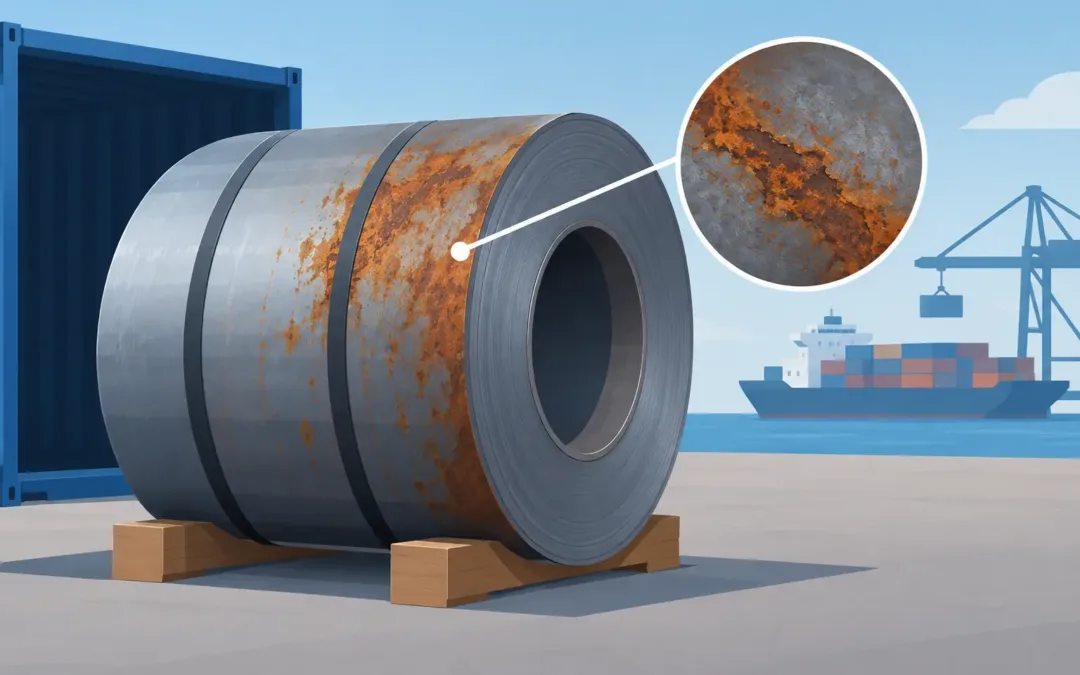
A steel coil rust damage example can turn on a few square feet of orange staining, a damp hatch coaming, or a warehouse receipt that lacks a timely exception. For cargo interests, carriers, insurers, and charterers, the visible corrosion is only the starting point. The decisive issue is whether the condition can be tied to a specific exposure event, period of custody, and measurable commercial loss.
Steel coils are susceptible to corrosion during ocean transit, port handling, and inland storage. Yet rust does not automatically establish carrier liability or prove that a coil is unfit for its intended use. An effective cargo condition survey separates surface discoloration from material damage, identifies the likely moisture source, and preserves the evidence needed for a defensible claim decision.
Steel Coil Rust Damage Example: From Discharge to Claim
Consider a shipment of cold-rolled steel coils discharged at a Gulf Coast terminal after an ocean voyage. At out-turn, the receiving tally identifies rust staining on the outer wraps of several coils. Two coils show heavier corrosion concentrated at the crown and along one side of the eye. Their protective paper is softened, edge protectors are wet, and portions of the outer steel strapping show oxidation.
The cargo receiver places the shipment on hold and requests an independent survey. The surveyor attends before stripping, reconditioning, or moving the affected coils. This timing matters. Once packaging is removed or coils are relocated, evidence of how moisture entered and traveled through the cargo can be lost.
The initial inspection records coil identification numbers, heat numbers where visible, dimensions, weight markings, packaging condition, stowage position, and the extent of corrosion. Wide-angle photographs establish the cargo’s location and general condition. Closer images document wet wrapping, tide marks, corrosion patterns, damaged bands, and any openings in protective covers. The survey record also notes whether the coils were stored upright, on saddles, or directly on a wet surface.
In this example, the corrosion is not uniform. It is most severe on coils stowed below a hatch area reported to have experienced water ingress during heavy weather. Adjacent units show damp packaging but limited staining. That pattern is consistent with localized external water exposure, although it does not by itself establish when the exposure occurred or who controlled the cargo at that time.
What the Rust Pattern Can and Cannot Establish
The appearance of rust often provides useful direction, but it is not a substitute for a proper causation analysis. Freshwater exposure, saltwater wetting, vessel sweat, cargo sweat, pre-shipment moisture, and terminal rain exposure can all produce corrosion. Their patterns and supporting evidence may differ significantly.
A localized vertical stain beneath a hatch area may support a leakage hypothesis. Condensation-related damage may be more diffuse, particularly where inadequate ventilation or temperature differentials occurred within a hold. Corrosion at the coil circumference combined with soaked protective paper can indicate water penetration through packaging. Rust confined to exposed edges may be less serious than corrosion that has migrated beneath wraps or affected surface finish across broad areas.
The commercial grade of the steel is equally relevant. Some products can be reconditioned through pickling, slitting, trimming, or downgraded sale. Other products, including exposed automotive-grade, coated, electrical, or precision cold-rolled steel, may have limited tolerance for surface defects. A surveyor should avoid declaring cargo a total loss based on appearance alone. The appropriate question is whether the documented condition prevents the coils from meeting their specified contractual or end-use requirements.
Pre-existing condition must also be considered. If rust is visible beneath intact original packaging, if loading photographs show staining, or if mill documentation records exceptions, the damage may have originated before vessel custody. Conversely, clean pre-loading survey records, dry packaging at load port, and contemporaneous evidence of wetting during transit can materially strengthen a cargo claim.
Evidence That Protects the Claim Position
Cargo claims involving steel coils are frequently decided by the quality and timing of the documentation rather than by the severity of rust alone. The survey file should create a clear chain from shipment condition through discharge, storage, mitigation, and final disposition.
The most useful evidence generally includes:
- Pre-shipment inspection records, loading photographs, mate’s receipts, and bills of lading showing apparent order and condition.
- Vessel records, including deck logs, weather reports, hatch-cover testing, ventilation records, and notices of water ingress or heavy-weather damage.
- Out-turn tally sheets, terminal condition reports, discharge photographs, exception notices, and warehouse receipts.
- Detailed coil-by-coil survey records documenting identification, packaging, rust location, severity, and estimated affected surface area.
- Laboratory or technical review where contamination, chlorides, coating failure, or a dispute over corrosion mechanism requires further analysis.
Not every claim requires laboratory testing. If the facts clearly establish rain exposure during terminal handling and the product is visibly affected, timely photography and custody records may be more valuable than a late technical analysis. On the other hand, where parties dispute whether corrosion resulted from saltwater, condensation, or an inherent packaging issue, sampling and specialized examination can be appropriate.
The surveyor should record observations without overstating conclusions. For example, stating that staining is “consistent with water exposure” is different from stating that water entered through a defective hatch cover. The latter conclusion requires evidence linking the condition to hatch integrity, the vessel’s stowage plan, weather exposure, and exclusion of other plausible sources.
Establishing the Scope of Damage
A common error is to inspect only the visibly affected outer wraps and apply the same conclusion to an entire lot. Corrosion can be limited to the outer circumference, or it can extend inward between laps where moisture has wicked through the coil. The scope of inspection should reflect the cargo value, the severity of wetting, and the likely disposition options.
Selective stripping under joint survey conditions can establish penetration depth without unnecessarily increasing damage. The process should be controlled: identify the coil, photograph packaging before removal, document each exposed layer, and retain representative samples where appropriate. If the receiver begins reconditioning before the other interested parties have an opportunity to inspect, the claim may become more difficult to quantify and defend.
The damage calculation should distinguish between physical condition and economic loss. A coil may be physically serviceable but commercially impaired because it can only be sold into a lower-value market. Conversely, an apparently severe outer-wrap condition may be corrected at modest cost if the underlying material remains within specification. Salvage value, reconditioning cost, inspection cost, handling expense, and mitigation outcomes should all be documented separately.
Why Vessel and Terminal Records Matter
For ocean-carriage claims, cargo evidence must be read alongside vessel-condition evidence. If water ingress is alleged, an Ultrasonic Hatch Cover Survey, hose test results, maintenance records, hatch-cleat condition, compression-bar condition, and prior defect reports can be relevant. A recent satisfactory test does not eliminate every possibility of ingress during exceptional weather, but it provides important context.
Stowage also matters. Coils placed beneath a known vulnerability, insufficiently protected from condensation, or exposed through damaged tarpaulins may face a different risk profile than coils stowed in a dry, well-maintained hold. Dunnage condition, separation from ship’s structure, drainage paths, and cargo securing arrangements should be recorded. In port, the survey should examine whether the cargo encountered rain during discharge, stood on wet pavement, or remained uncovered during transfer.
The custody timeline is often where a claim becomes clear. A coil discharged dry and received by a warehouse without exceptions presents a different evidentiary position from a coil found wet at vessel discharge. Delay can weaken that timeline quickly. Rust progresses, packaging dries, cargo moves, and the parties lose the ability to inspect the original condition jointly.
A Practical Response When Rust Is Found
When steel coil rust is identified, the first operational priority is preservation, not immediate disposal or rework. Segregate the affected coils, stop further exposure to moisture, and issue timely notices to relevant carriers, terminals, insurers, and contractual counterparties. Arrange an independent cargo condition survey before stripping packaging or undertaking substantial mitigation.
The next priority is proportionality. A small number of commodity-grade coils may justify a focused visual survey and market-based damage assessment. A high-value shipment, widespread corrosion, or a suspected seawater ingress event may require joint attendance, detailed sampling, hatch-cover investigation, and technical evaluation of usability. The scope should match the potential exposure and the evidentiary dispute.
For commercial stakeholders, the value of a well-executed survey is not simply a damage figure. It is a reliable factual record that allows the parties to decide whether to pursue recovery, negotiate a commercial settlement, recondition the cargo, or release sound material without unnecessary delay. When evidence is captured early and the custody record is complete, a rust claim can be managed as a controlled risk event rather than an open-ended dispute.
