
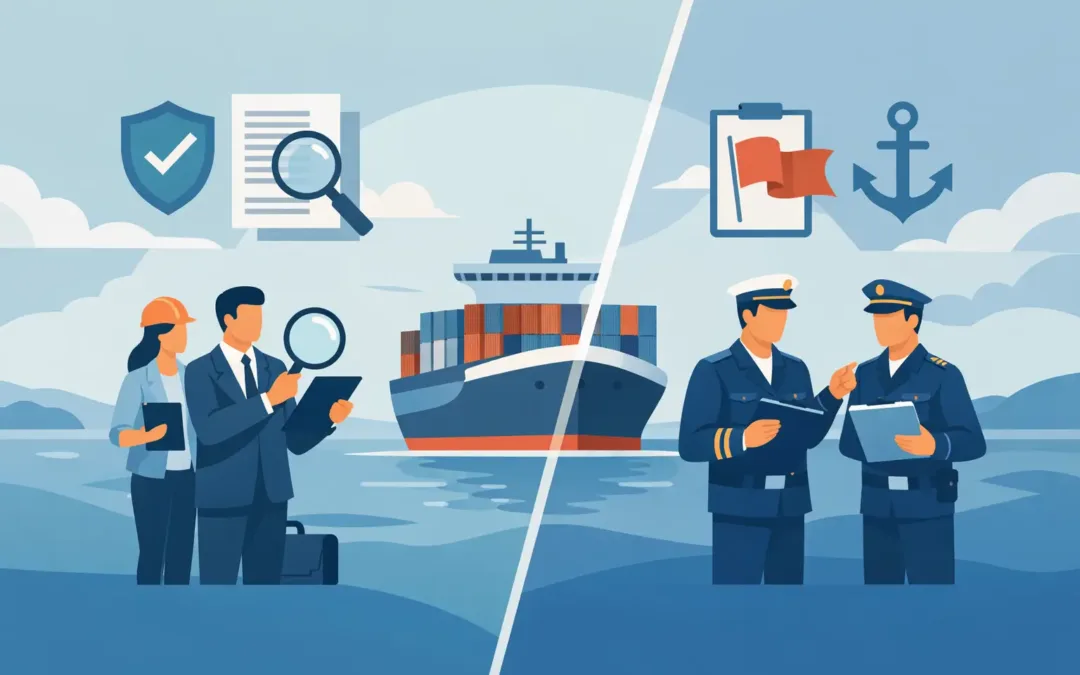
A vessel can appear operationally sound and still present two very different exposures: one to its insurer or P&I Club, and another to its Flag Administration. That distinction is central to P&I inspection versus flag inspection. Both may examine safety management, maintenance, crew practices, and statutory certificates, but they are commissioned for different reasons, carry different authority, and lead to different consequences.
For owners, operators, charterers, and claims teams, treating the two as interchangeable can leave critical gaps in vessel risk control. A clean P&I survey does not replace flag-state compliance, and valid statutory certification does not prove that a vessel represents an acceptable insurance risk.
What a Flag Inspection Is Designed to Establish
A flag inspection is performed under the authority of the vessel’s Flag Administration, or by a recognized organization acting on its behalf. Its primary purpose is to establish whether the vessel complies with applicable international conventions, flag-state requirements, and the conditions attached to statutory certificates.
The inspection may address the condition and operation of safety equipment, lifesaving appliances, firefighting systems, navigation arrangements, radio equipment, pollution-prevention controls, machinery, load line requirements, crew certification, and the vessel’s safety-management documentation. The exact scope depends on vessel type, trading area, survey cycle, and the authority conducting the inspection.
The result has regulatory weight. Material deficiencies can require correction, impose operational limitations, affect certificate validity, or lead to detention where deficiencies are identified during port-state control. In practical terms, the flag inspection asks whether the vessel meets the legal and technical baseline required to remain in service under its flag.
That baseline matters, but it is not the same as a commercial assessment of the vessel’s broader loss potential. Statutory compliance is a threshold, not a guarantee that every operational exposure has been identified or adequately controlled.
What a P&I Inspection Is Designed to Identify
A P&I inspection is generally a risk-focused condition and operations review performed for a Protection and Indemnity interest, marine insurer, manager, or another party with exposure to third-party liabilities. Its purpose is preventive: identify conditions, practices, or management weaknesses that could lead to crew injury, cargo damage, pollution, collision liability, property damage, or a costly claim.
The surveyor may review areas that overlap with a statutory inspection, such as firefighting readiness, enclosed-space entry controls, deck condition, machinery housekeeping, and safety-management records. The key difference is the lens applied. A P&I inspection considers whether the vessel’s actual condition and onboard practices create unacceptable claims exposure, even where a certificate remains valid.
A P&I survey may place particular attention on practical evidence. Are hatch covers weathertight in service, not merely recorded as tested? Are cargo holds clean, dry, and suitable for the intended commodity? Are mooring lines, winches, gangways, access arrangements, and pilot ladders maintained to a condition that reduces injury and third-party liability? Are ballast, bunkering, garbage, and pollution-prevention routines being followed at the working level?
Findings commonly lead to risk recommendations, corrective-action requests, follow-up surveys, or underwriting decisions. Depending on the party commissioning the work, unresolved matters may affect terms of entry, coverage conditions, deductibles, premiums, or the willingness to insure a particular vessel or operation.
P&I Inspection Versus Flag Inspection: The Core Difference
The clearest distinction is authority. A flag inspection is conducted to verify compliance with legal and flag-state obligations. A P&I inspection is conducted to evaluate insurable risk and prevent liability-producing events.
The distinction also changes the inspection standard. Flag surveyors assess conformity against defined statutory requirements and certification criteria. P&I surveyors assess condition, behavior, maintenance culture, and operational safeguards against the practical risk of a casualty or claim. A corroded handrail, poor housekeeping in a machinery space, incomplete near-miss records, or inconsistent cargo-watch practices may concern a P&I inspector even before they rise to the level of a statutory deficiency.
Their reporting paths differ as well. Flag inspection results are reported to the administration or recognized organization and may directly affect certification status. P&I findings are ordinarily reported to the instructing insurer, Club, owner, manager, or broker, subject to the assignment terms. The report becomes a risk-management record that can support corrective action, underwriting review, and, when needed, claims analysis.
Neither type of inspection should be viewed as less demanding. They address different questions. One asks, “Is the vessel compliant and certifiable?” The other asks, “Where is this vessel most likely to generate a preventable liability loss?”
Where the Scopes Overlap – and Where They Do Not
Overlap is common. Both inspections may review fire safety, lifesaving appliances, pollution controls, navigational safety, crew competency, and the implementation of the Safety Management System. A serious defect found by either inspector may warrant immediate attention.
However, the P&I scope can extend more deeply into claim-producing scenarios. For a bulk carrier preparing to load a moisture-sensitive cargo, a P&I or cargo-risk survey may focus on hatch-cover integrity, hold condition, water-ingress risks, loading communication, and documentary controls. For a tanker, it may focus on transfer procedures, spill-prevention readiness, manifold arrangements, and terminal interface controls. For a vessel with frequent crew changes, it may assess familiarization, permit-to-work discipline, and the quality of onboard supervision.
A flag inspection may identify deficiencies in these same areas if statutory noncompliance is present. It may not, however, be commissioned to assess the commercial adequacy of cargo protection procedures, charter-party exposure, or the likelihood that an incident will become a major P&I claim.
How Operators Should Respond to Each Inspection
The best response is disciplined correction, not defensive debate. When a flag deficiency is raised, the operator must determine whether immediate repair, operational restriction, notification to class or flag, or certificate action is required. Evidence of closure should be specific: repair records, service reports, photographs, test results, replacement certificates, and updated procedures where applicable.
When a P&I finding is raised, the response should address the root cause as well as the visible condition. If a pilot ladder inspection reveals damaged steps or inadequate securing arrangements, replacing the ladder is necessary but may not be sufficient. The operator should also verify procurement standards, inspection intervals, crew training, and records across the managed fleet where the same failure could recur.
Timing matters. An open recommendation may be manageable during a scheduled repair period if the risk is controlled and the instructing party agrees. It may be unacceptable before a high-risk voyage, a cargo operation, a port call with heightened scrutiny, or a vessel sale. The correct action depends on severity, trading commitments, class and flag implications, and the potential consequence of failure.
Using Independent Surveys to Close the Gap
Independent inspection support is especially valuable when a vessel faces insurance scrutiny, recurring deficiencies, a casualty-related review, or time-sensitive cargo operations. An independent surveyor can document actual condition, verify remedial work, conduct targeted checks such as ultrasonic hatch-cover testing, and provide objective evidence for insurers, managers, charterers, or legal teams.
For example, a vessel may hold valid statutory certificates while cargo interests remain concerned about water ingress after previous wet-damage claims. A focused hatch-cover, hold-condition, and cargo-readiness survey can establish the physical condition and operational controls relevant to that exposure. Conversely, a P&I recommendation may identify a serious safety weakness that should be escalated promptly to flag, class, or the company’s designated person ashore.
Zeus Marine and Cargo Solutions LLC provides independent vessel, cargo, and insurance inspection support for these assignments, including short-notice attendance when operational or claims exposure cannot wait for the next scheduled survey.
Build One Corrective-Action Record
Separate inspections should not produce separate silos of information. Operators benefit from one controlled corrective-action record that identifies the finding, source, risk rating, responsible party, required action, target date, verification method, and closure evidence. This allows technical management, HSEQ personnel, insurers, and commercial teams to distinguish between a statutory requirement, an insurance recommendation, and a broader operational improvement.
The record should also capture recurring themes. Repeated issues with access safety, maintenance execution, enclosed-space procedures, cargo contamination controls, or onboard documentation often indicate a management-system weakness rather than isolated vessel defects. That is where preventive intervention delivers greater value than repeatedly closing the same observation.
A vessel does not become lower risk simply because it passes one form of inspection. The stronger position is to use flag oversight to protect compliance, P&I inspection to expose liability risk, and independent evidence to demonstrate that corrective action is complete before the next voyage puts the issue to the test.
