
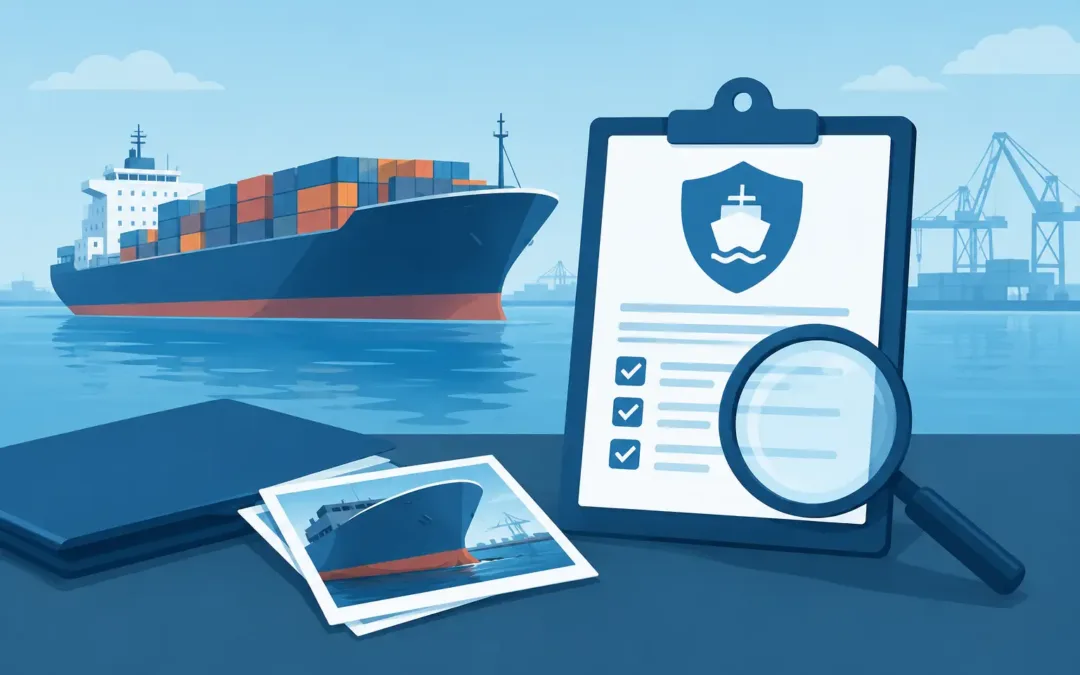
A wet cargo hold, a disputed draft figure, a damaged coil discovered at discharge – each can become a claim file within hours. Marine insurance evidence determines whether that file explains what happened or merely records that a loss was reported. For owners, charterers, cargo interests, insurers, and P&I stakeholders, the difference is material: evidence must connect condition, custody, causation, extent of loss, and mitigation in a form that can withstand technical and contractual scrutiny.
The strongest record begins before a casualty is alleged. It is assembled through disciplined observations at the points where risk changes hands: loading, transit, bunkering, port calls, discharge, and post-incident response. A survey report filed after the fact may help, but it cannot recreate readings that were never taken, seals that were never checked, or damage that was not photographed before cargo was moved.
What Marine Insurance Evidence Must Prove
Insurance evidence is not simply a collection of photographs and emails. It must establish a reliable factual sequence. That sequence normally addresses the cargo or vessel’s condition, the applicable operational requirements, who had control at each stage, when an exception was identified, and what action followed.
For cargo claims, the central questions are usually straightforward but rarely simple to answer. Was the cargo sound when received? Was the packaging adequate for the voyage and handling method? Did exposure occur before loading, during sea passage, at a terminal, or after delivery? Was the quantity short at origin, at discharge, or only in the documentation? Independent findings matter because commercial parties may have competing accounts of those events.
For hull, machinery, P&I, and operational claims, the record must often go further. It may need to address seaworthiness, maintenance history, class or statutory status, weather exposure, navigation records, crew actions, machinery alarms, pollution-control measures, or third-party damage. The relevant standard depends on the policy, charter party, bill of lading, applicable regulations, and the immediate facts of the loss.
Evidence does not need to prove every issue alone. It does need to be authentic, contemporaneous, and traceable. A clear survey report can carry significant weight when it identifies the inspection scope, location, date and time, persons present, methods used, instruments employed, limitations observed, and the basis for each conclusion.
The Evidence Chain Starts Before the Incident
Pre-loss surveys are often treated as routine compliance work. In practice, they create the baseline against which later allegations are measured. A pre-shipment inspection may document packaging condition, marks, apparent cargo quality, and visible damage. A pre-loading survey can verify that the cargo presented is consistent with shipping instructions and suitable for loading. A pre-vetting or condition survey can identify vessel deficiencies before an insurer, charterer, or cargo interest assumes unnecessary exposure.
For moisture-sensitive cargoes, hatch-cover condition is a frequent evidentiary issue. An Ultrasonic Hatch Cover Survey provides a documented assessment of weathertight integrity before loading. If wet damage is later reported, the result does not automatically resolve causation. It does, however, establish whether the hatch system passed testing at a known point in time and whether recommendations or deficiencies were recorded.
The same principle applies to stowage and securing. A stowage and lashing review should identify the cargo arrangement, securing method, condition of securing materials, compatibility of adjacent cargoes, and any departure from the approved cargo securing manual or agreed loading plan. When cargo shifts, collapses, or sustains contact damage, those observations may be central to determining whether the loss arose from sea conditions, inadequate securing, terminal handling, or a combination of factors.
Quantity evidence also requires a baseline. Draft surveys, shore-tank comparisons, tally records, scale tickets, meter readings, and bunker measurements should be reconciled while the operation is active. Once cargo has left the terminal or a vessel has sailed, a discrepancy becomes harder and more expensive to investigate.
Survey Records That Carry Weight
A defensible survey file relies on facts that another qualified professional can review and follow. Reports should state what the surveyor observed directly and distinguish those observations from information supplied by crew, terminal personnel, shippers, or agents. This distinction is especially valuable when witness accounts conflict.
Photographs are useful only when they are identifiable and relevant. Image sets should show the overall context before close-up damage, include cargo marks or location references where possible, and preserve original files. A photograph of a crushed package is less persuasive if the report cannot establish whether it was found in a warehouse, on a quay, inside a container, or in a vessel’s hold.
Measurements require equal discipline. A quantity report should record the method used, calculation basis, calibration status where applicable, environmental conditions that affect readings, and supporting source documents. For bunker quantity and quality disputes, this may include sounding records, tank tables, temperature and density data, sampling procedures, sample seals, chain-of-custody information, and laboratory documentation.
Document control is not administrative overhead. It protects evidentiary integrity. Survey notes, statements, vessel records, cargo documents, electronic data, and correspondence should be preserved in their original form and organized under a clear file structure. If revised reports are issued, the reason for revision should be apparent. Missing pages, altered timestamps, unreferenced attachments, and unexplained calculation changes can undermine an otherwise sound claim position.
Responding When Damage Is Found
The first hours after a discovery are often decisive. Cargo may be moved, repacked, commingled, salvaged, or released before a surveyor arrives. Vessel conditions can change after pumping, ballasting, repairs, cleaning, or weather improvement. A delayed response can leave the parties debating possibilities instead of examining evidence.
The immediate objective is not to assign blame prematurely. It is to preserve the scene, prevent further loss, and document the condition before the evidence changes. The responsible party should notify relevant interests under the governing contractual and insurance requirements, identify cargo or equipment at issue, and request an independent survey where warranted.
At a damage survey, the scope should fit the exposure. It may include examination of packaging, holds, containers, lashings, hatch covers, bilges, drainage paths, vessel logs, terminal handling equipment, temperature records, and cargo segregation. Sampling may be appropriate for contamination, wet damage, or quality deterioration, but only where the sampling plan, sealing process, and chain of custody are controlled.
Mitigation must also be recorded. If wet cargo is separated, damaged steel is reconditioned, contaminated product is treated, or repairs are made to avoid escalation, document the condition before work begins and the method used. Claims handlers need a reliable basis to distinguish the original loss from the cost and effect of mitigation.
Common Gaps That Weaken a Claim File
Many disputes become difficult because the underlying event is complex. Others become difficult because essential records were overlooked. Four recurring gaps deserve attention:
- Late appointment of an independent surveyor. By the time attendance occurs, cargo may have been moved or a vessel condition may have been altered.
- Unverified assumptions about custody. A handoff between vessel, terminal, trucker, warehouse, and receiver can create uncertainty unless timestamps and exchange records are clear.
- Generic damage descriptions. Terms such as “damaged,” “wet,” or “short” are insufficient without quantity, location, pattern, severity, and supporting observations.
- Failure to reconcile documents. Bills of lading, mate’s receipts, tally sheets, statements of facts, draft calculations, delivery receipts, and survey findings must be reviewed together, not in isolation.
Not every loss requires the same level of investigation. A minor, undisputed package claim may be resolved with a focused inspection and supporting photographs. A high-value bulk cargo discrepancy, machinery casualty, contamination allegation, or suspected seawater ingress demands a broader evidence plan. The correct response depends on the commodity, policy terms, commercial exposure, likely forum, and risk of evidence being lost.
Coordinating Technical Findings With Claims Strategy
Surveyors should not determine coverage or advocate a party’s legal position. Their role is to provide an independent technical record that claims handlers, underwriters, P&I correspondents, and legal teams can use. That independence is particularly valuable when facts are developing quickly and several stakeholders are present at the scene.
A well-scoped instruction improves the result. Identify the suspected issue, location, cargo or vessel involved, timing, required measurements, documents to review, parties to notify, and whether joint attendance is needed. At the same time, leave room for the surveyor to report unexpected conditions that may affect cause, extent, safety, or mitigation.
Zeus Marine and Cargo Solutions supports this process through cargo condition and damage surveys, quantity verification, draft surveys, bunker surveys, hatch-cover testing, P&I inspections, and vessel-condition services. For time-sensitive cases, short-notice deployment can protect evidence before cargo movement or vessel operations make the factual record harder to establish.
A claim file gains strength when evidence is gathered as part of the operation, not assembled later under pressure. Establish inspection triggers before loading and discharge, preserve original records when an exception appears, and bring in independent technical attendance before the scene changes. That discipline gives every party a clearer factual foundation when the commercial stakes are highest.
