
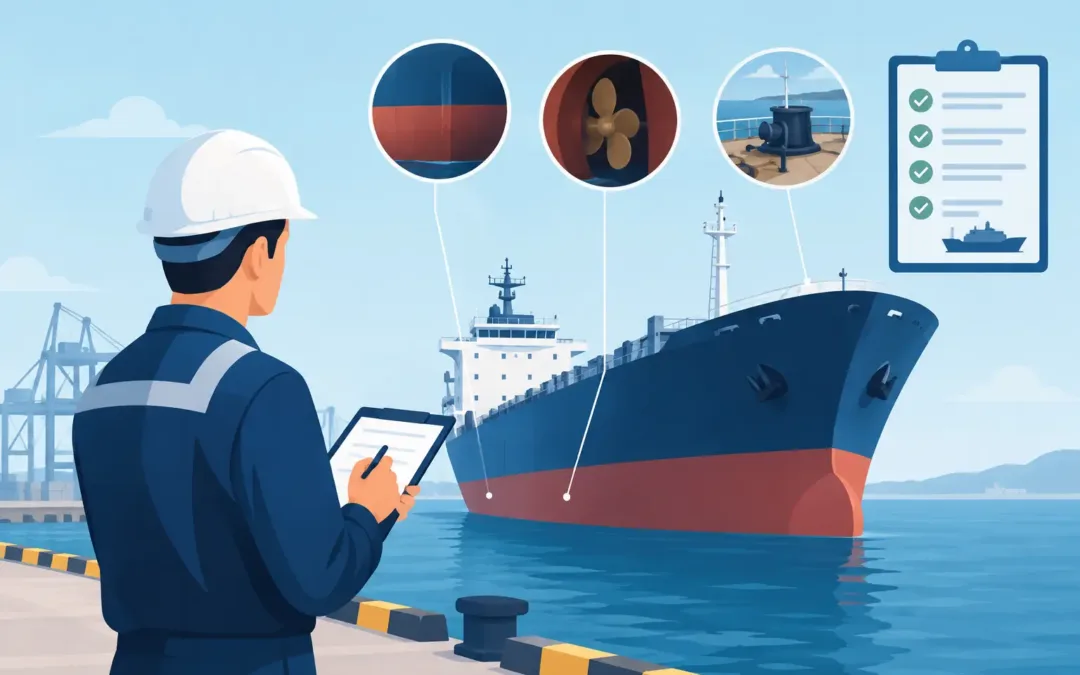
A guide to ship condition reporting is not a checklist exercise completed after the vessel has sailed. It is a controlled record of what was observed, where it was observed, how it was verified, and what operational or claims exposure may follow. For owners, charterers, cargo interests, P&I representatives, and underwriters, the value of the report rests on whether its findings can be understood and defended when a dispute, casualty, detention, or cargo claim develops.
A useful report distinguishes between normal wear, maintenance deficiency, immediate safety concern, and condition that may affect seaworthiness, cargo integrity, or contractual performance. It also records the limits of the attendance. A surveyor cannot report on spaces that were inaccessible, machinery that was not operated, or documents that were not presented. That clarity protects every party relying on the report.
What Ship Condition Reporting Is Designed to Establish
Ship condition reporting creates an independent snapshot of a vessel at a defined time and place. Depending on the assignment, it may support a pre-purchase decision, chartering review, P&I inspection, pre-vetting exercise, port-call assessment, damage investigation, or insurance claim. The intended use should shape the scope before the survey begins.
A pre-purchase condition survey may examine hull structure, machinery, electrical systems, safety equipment, cargo spaces, records, and maintenance history in substantial depth. A charterer’s inspection may focus more closely on cargo-worthiness, hatch-cover integrity, cleanliness, operational readiness, and recurring deficiencies that could interrupt a voyage. Following an incident, the report must preserve evidence, identify probable mechanisms of damage where supportable, and avoid conclusions that exceed the evidence available.
The central question is practical: can the vessel safely and reliably perform the work expected of it? The answer may depend on the vessel type, cargo, trading area, class status, weather exposure, port restrictions, and time available for corrective action.
Define the Scope Before Boarding
An effective condition report starts with written instructions. The appointing party should identify the vessel, location, purpose of attendance, intended readers, priority concerns, and any relevant contractual or claims context. Surveyors should confirm whether the assignment requires a general condition assessment, targeted inspection, inventory verification, damage documentation, or review of particular systems.
Scope discipline matters because a broad statement such as “vessel inspected” can create false assumptions. If the attendance covered accessible deck areas and cargo holds only, the report should say so. If the main engine was running but not tested under load, that limitation belongs in the report. If the vessel was afloat and no underwater hull examination was possible, that is material.
Before boarding, review available vessel particulars, class and statutory status, recent port-state-control history where provided, cargo information, prior survey reports, maintenance records, incident notifications, and relevant photographs. These records do not replace physical inspection. They help direct attention to areas where evidence is most likely to matter.
Inspect Systematically and Record Conditions Precisely
A defensible ship condition report follows a logical route through the vessel rather than relying on general impressions. The route will vary by vessel type, but it should allow findings to be traced to a specific location and operating condition.
For a cargo vessel, the survey commonly addresses external hull condition above the waterline, weather decks, bulwarks, mooring arrangements, access points, hatch covers, coamings, drains, cargo holds, bilges, ladders, ventilation closures, and cargo securing arrangements. Where the scope permits, the survey may also cover engine-room housekeeping, machinery condition, emergency systems, electrical installations, steering gear, fire-fighting equipment, lifesaving appliances, navigation spaces, and accommodation safety conditions.
Descriptions should be factual and measurable. “Corrosion observed” is rarely enough. A stronger entry identifies the location, extent, apparent severity, and associated consequence: “Localized steel wastage and coating breakdown observed at No. 2 hatch coaming port-forward corner, extending approximately 1.2 meters. Rust scale was present around the drain channel. Condition may impede effective drainage and requires close-out inspection before loading moisture-sensitive cargo.”
The report should separate observed facts from professional opinion. A surveyor may state that a hatch-cover compression bar showed deformation, that packing appeared hardened, and that water-testing was recommended. Declaring the hatch completely weathertight without an appropriate test would be unsupported.
Evidence That Holds Up Under Scrutiny
Photographs are often the first evidence reviewed after an incident, but photographs without context have limited value. Each image should be tied to the finding through a caption or reference number stating the location, direction of view, relevant scale, and observed condition. Wide-angle images establish context; close images show detail. A measuring scale, where safe and practical, gives damage or wastage greater evidentiary value.
Time, date, vessel name, berth or anchorage, weather, lighting, and access conditions should be recorded. When a condition is obscured by cargo, standing water, paint, insulation, or inaccessible staging, document that constraint. Do not let an unclear image become the sole support for a major conclusion.
Crew statements can be useful, particularly on the history of leaks, machinery alarms, repairs, or operational limitations. Attribute those statements rather than presenting them as independently verified facts. For example: “Chief Officer advised that minor water ingress had previously occurred at the subject hatch during heavy-weather passages.” The report can then state whether available observations support, contradict, or do not confirm the statement.
Classify Deficiencies by Operational Risk
Not every deficiency requires the same response. A good reporting framework ranks findings so decision-makers can prioritize corrective action without losing sight of lower-level maintenance issues.
Critical findings are conditions that present an immediate risk to life, pollution prevention, safe navigation, structural integrity, or cargo safety. Examples may include ineffective emergency equipment, unsafe access, material hatch-cover leakage, compromised cargo securing, serious fire-safety deficiencies, or machinery conditions that materially affect propulsion or steering reliability. These require prompt notification to the responsible vessel representative and clear documentation of the notification.
Significant findings may not stop an operation immediately but can develop into a material risk if left open. Recurrent coating failure in cargo spaces, degraded weather seals, deficient bilge arrangements, or damaged guardrails may fall into this category depending on extent and service conditions. Routine findings include housekeeping, minor corrosion, labeling, or maintenance deficiencies that should be entered into the vessel’s planned maintenance process.
Risk ratings should never be arbitrary. The same crack, leak, or equipment defect can carry different consequences on different vessels and voyages. Cargo type, anticipated weather, port requirements, redundancy, and available repair opportunities all affect the assessment.
Include Documents, Tests, and Limitations
Condition reporting is stronger when the report distinguishes visual observations from document review and operational testing. If certificates were examined, identify the documents and their apparent validity dates. If an ultrasonic hatch cover survey, hose test, operational run, insulation resistance test, or other examination was performed, state the method, conditions, results, and relevant limitations.
For example, a hatch cover may appear serviceable during a visual inspection while still requiring ultrasonic testing to evaluate potential water-ingress paths. Conversely, a failed test result should be reported with enough detail to identify the hatch panel, test area, pressure or equipment used where applicable, and observed leakage path. This allows repair teams and claims handlers to work from the same record.
Limitations are not weaknesses when properly stated. They define the boundary of the survey evidence. Restricted access, weather delays, cargo operations, vessel movement, unavailability of crew, absence of records, and time constraints should be recorded without speculation.
Turn Findings Into Corrective Action
A condition report should make the next action clear. Each significant finding needs a recommended response proportionate to the risk: immediate isolation, temporary repair, permanent repair, further testing, class consultation, manufacturer review, or monitoring at the next port. Recommendations should identify urgency without directing repairs beyond the surveyor’s evidence or authority.
The report should also identify whether corrective action was completed during attendance. If a crew member fitted a missing guardrail chain or cleared a blocked drain, record the original condition, the observed action, and whether the remedy was verified. Do not mark a deficiency closed solely because corrective action was promised.
For time-sensitive port calls and claims matters, issue a preliminary notification promptly when a critical condition is found, followed by a formal report with photographs, findings, limitations, and supporting records. Fast communication reduces exposure, but speed should not compromise accuracy or chain of evidence.
Use Independent Reporting When the Stakes Are High
When cargo condition, seaworthiness, off-hire exposure, insurance recovery, or potential litigation is involved, independence matters. An experienced marine surveyor can document condition without becoming part of the vessel’s operational chain of command, while communicating urgent risks to the appropriate parties.
Zeus Marine and Cargo Solutions provides vessel condition inspections, P&I inspections, hatch-cover assessments, cargo surveys, and rapid-response support for assignments where accurate evidence and practical risk identification are required. The most useful report is the one that gives commercial parties a clear record before uncertainty becomes a dispute.
