
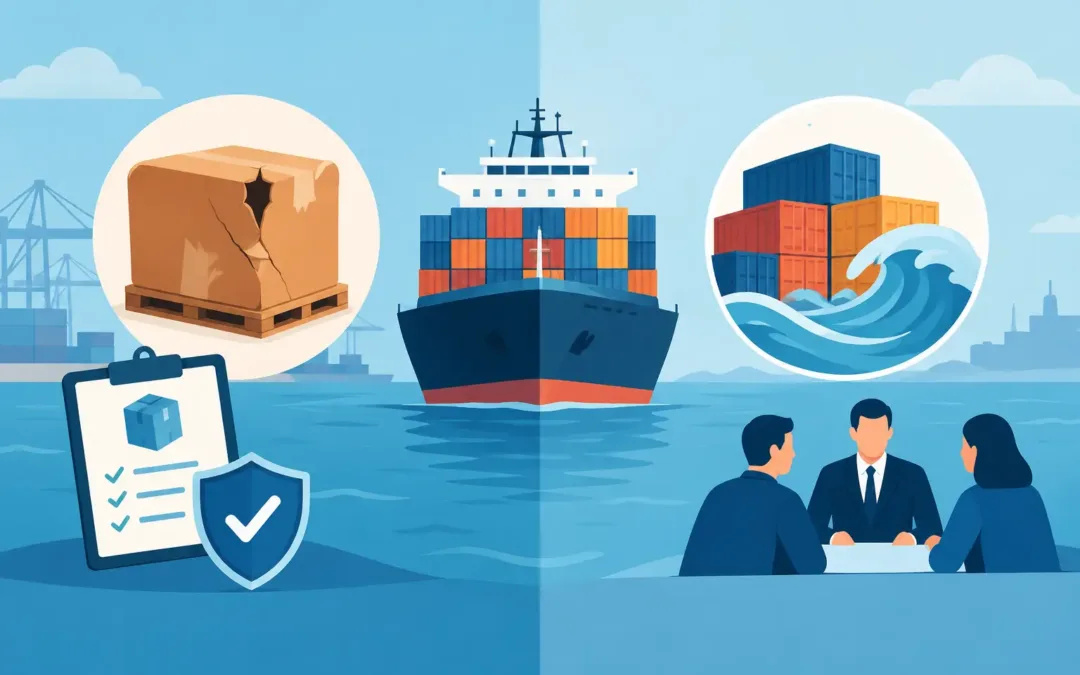
A cargo claim versus general average decision can determine whether a cargo interest pursues recovery for damage or must provide security before its shipment is released. The events may arise from the same casualty – a fire, grounding, machinery failure, or heavy-weather incident – but the commercial and legal pathways are fundamentally different. Early classification, prompt evidence preservation, and independent survey attendance are critical.
Cargo Claim Versus General Average: The Core Distinction
A cargo claim generally concerns physical loss, damage, shortage, contamination, delay-related exposure, or another breach of a carrier’s obligations. The cargo owner, insurer, or subrogated insurer seeks compensation from a party believed to be responsible, often the ocean carrier, terminal, stevedore, forwarder, or another contractual counterparty. Liability turns on the governing contract of carriage, applicable law, the facts of the casualty, and the available defenses.
General average is not a damages claim against a responsible party. It is a centuries-old maritime principle under which parties to a common maritime adventure share certain extraordinary expenditures or sacrifices made intentionally and reasonably to preserve the vessel, cargo, and freight from a common peril. If a master orders firefighting measures, emergency port expenses, salvage-related action, or a deliberate sacrifice of property for common safety, the resulting qualifying cost may be distributed among the interests that benefited.
That distinction has immediate consequences. A cargo claimant commonly focuses on causation, condition, fault, notice requirements, and the value of its loss. A cargo interest facing general average focuses first on release of cargo, the required security, the adjustment process, and its eventual contribution. The same cargo may be both damaged and subject to general average, so these tracks should not be treated as mutually exclusive.
What Creates a Cargo Claim?
Cargo claims arise when goods are delivered in a condition or quantity that differs from the contractual and documentary expectation. Wet damage to bagged commodities, steel corrosion linked to water ingress, temperature excursion in refrigerated cargo, contamination of bulk cargo, and tally shortages are familiar examples. The central question is typically whether a legally responsible party failed to meet its duty of care or contractual obligation.
The bill of lading, charter party, booking terms, survey records, mate’s receipts, loading plans, terminal records, cargo specifications, and notices of protest can all affect the outcome. So can evidence of inherent vice, insufficient packaging, latent defect, improper declaration, or pre-existing condition. A damaged shipment does not automatically establish carrier liability, and a clean bill of lading does not eliminate the need to investigate the actual condition at loading and discharge.
A defensible cargo claim usually requires a disciplined factual record. That record should establish the nature and extent of damage, probable cause, quantity affected, segregation measures, mitigation costs, salvage value, and the chain of custody for samples or retained evidence. Where conditions permit, surveyors should document cargo before movement, rehandling, disposal, or commingling changes the evidence.
Liability Is Fact-Specific
For cargo interests, the commercial instinct is often to identify who will pay. That question is necessary, but it should follow technical investigation rather than replace it. A hatch cover deficiency may point toward seawater ingress, while damaged packaging, improper stowage, ventilation failures, cargo sweat, or shore handling may point elsewhere. Multiple causes can exist, and allocation may differ among parties.
Timely notice also matters. Cargo interests should preserve rights under the applicable carriage terms while avoiding unsupported conclusions about cause or liability. A joint survey can be useful, but an independent surveyor’s contemporaneous observations frequently provide the clearer evidentiary foundation when interests later diverge.
What Creates General Average?
General average requires more than a casualty and more than an expensive response. In broad terms, there must be a real common peril, an intentional and reasonable act or expenditure to preserve the property involved in the common adventure, and a successful outcome to some degree. The adjustment is commonly prepared under the York-Antwerp Rules when incorporated into the contract of carriage, although the applicable wording, rule version, and governing law must be confirmed in each matter.
Typical general average events include a vessel diverting to a port of refuge after a serious casualty, firefighting actions, salvage operations, temporary repairs required for safe continuation, or sacrifice of cargo or equipment to refloat or stabilize the vessel. Not every port call, repair invoice, cargo discharge, or delay cost qualifies. The adjuster examines whether each item was extraordinary, connected to common safety, properly incurred, and allowed under the governing rules.
Once general average is declared, cargo may not be released until the cargo interest provides an average bond and, where required, an average guarantee from its cargo insurer or a cash deposit. This security does not establish final liability or fix the amount due. It allows the adjustment process to proceed while protecting the parties funding the common-safety measures.
Contribution Is Based on Contributory Values
The ultimate general average contribution is not simply a percentage of the damaged cargo claim. It is calculated against contributory values of the saved interests, subject to the applicable rules and adjustment. Cargo interests may therefore face a contribution even if their own goods were not physically damaged. Conversely, cargo sacrificed for common safety may receive an allowance in general average.
Insurance coverage requires careful review. Marine cargo policies commonly respond to general average contributions and salvage charges, but deductibles, policy conditions, exclusions, and the scope of coverage matter. Uninsured cargo interests may need to arrange security directly, which can create significant cash-flow pressure during a time-sensitive release.
When Both Issues Exist After One Casualty
Consider a container vessel that suffers an engine-room fire and diverts to a port of refuge. Firefighting and emergency services may lead to a general average declaration. At the same time, certain containers may have smoke damage, heat exposure, firefighting-water damage, or delays that create separate cargo claim issues.
The general average question is whether the emergency actions and associated expenditures qualify for collective contribution. The cargo claim question is whether the cargo damage resulted from a legally actionable failure, such as unseaworthiness, deficient maintenance, negligent handling, or another breach. The carrier may have defenses, and a general average adjustment may reserve issues of fault for later resolution under the applicable contract and law.
This is why cargo interests should avoid treating a general average guarantee as an admission that no cargo claim exists. Likewise, a cargo damage allegation does not by itself excuse a party from general average security obligations. The documents should be reviewed separately, while the casualty evidence is managed as one coordinated record.
Evidence That Protects the Commercial Position
The first hours after a casualty are often decisive. Cargo condition can deteriorate rapidly, particularly with refrigerated products, hygroscopic commodities, steel, chemicals, and bagged goods. Vessel repairs, discharge operations, cargo relocation, and cleanup can also remove evidence needed to evaluate causation.
An independent marine survey should be scoped to the event. For cargo damage, this may include condition surveys, photo documentation, package or hold examination, sampling protocols, quantity and tally verification, temperature review, and evaluation of stowage, lashing, ventilation, and water-ingress pathways. For a suspected vessel-related cause, ultrasonic hatch cover testing, weather-tightness observations, log review, and assessment of relevant machinery or safety systems may be necessary.
For general average matters, survey evidence may support the factual basis for emergency decisions, identify sacrificed or damaged property, document discharge and reloading operations, and distinguish common-safety measures from routine commercial activity. Surveyors do not replace the appointed average adjuster or legal counsel, but their factual findings can materially support adjustment review, coverage analysis, and recovery strategy.
A Practical Response After Notice of Casualty or General Average
Cargo interests should first secure the documents that define the transaction: bills of lading, commercial invoices, packing lists, cargo insurance terms, charter-party provisions where available, notices from the carrier or adjuster, and all cargo handling records. They should then give prompt notice to insurers and relevant contractual parties, preserving deadlines without prematurely conceding cause or liability.
Next, arrange attendance before cargo is released, moved, sold, or destroyed where practicable. The scope should address both immediate mitigation and later claims requirements. A survey instruction that only requests a damage estimate may miss the vessel, stowage, quantity, or documentary evidence needed to establish why the loss occurred.
Finally, separate operational decisions from final allocation. Cargo may need rapid release, mitigation, reconditioning, or disposal. General average security may be required before commercial movement can resume. Those actions should proceed under a documented reservation of rights where appropriate, with evidence retained for insurers, adjusters, counsel, and commercial stakeholders.
A casualty does not wait for the claims file to be organized. Prompt, technically grounded survey evidence gives cargo and vessel interests a reliable basis to protect the shipment, meet security requirements, and preserve their position as the facts develop.
