
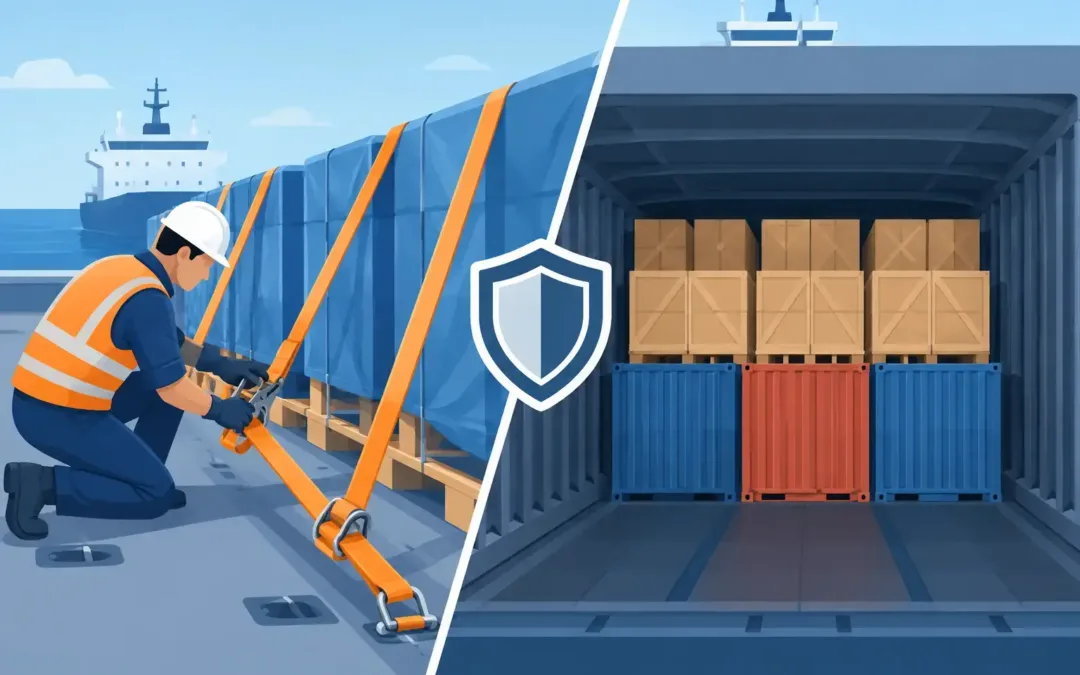
A cargo casualty can begin long before a securing chain fails. In the practical debate of lashing versus stowage, the issue is not which control matters more. Stowage determines whether cargo is positioned correctly for the voyage. Lashing determines whether that positioned cargo remains restrained when the vessel moves. Both must perform as an integrated system if owners, charterers, cargo interests, and insurers expect safe delivery and defensible survey evidence.
For project cargo, steel products, machinery, containers, forest products, and breakbulk, treating either discipline as an afterthought can create exposure. A sound lashing arrangement cannot fully correct poor cargo placement, excessive stack height, inadequate dunnage, or a loading sequence that concentrates weight improperly. Equally, properly planned stowage will not prevent shifting if the securing arrangement is unsuitable, incomplete, or poorly maintained.
Lashing Versus Stowage: The Operational Difference
Stowage is the planned placement, segregation, support, and distribution of cargo within a hold, on deck, or in a container. It addresses where cargo is carried, how it bears on the vessel structure, what it may contact, and whether it can be safely accessed, discharged, and protected throughout the voyage. A stowage plan must account for cargo characteristics, weight distribution, vessel stability, deck or tank-top loading limits, moisture sensitivity, compatibility, ventilation requirements, and the anticipated loading and discharge sequence.
Lashing is the physical restraint system that prevents cargo movement relative to the vessel or transport unit. Depending on the cargo, it can include chains, wires, web lashings, turnbuckles, twistlocks, bridge fittings, stoppers, chocks, cribbing, welded restraints, and other approved securing devices. Its purpose is to resist longitudinal, transverse, and vertical forces generated by rolling, pitching, heaving, vibration, acceleration, and severe weather.
The distinction is straightforward but commercially significant: stowage manages cargo location and support; lashing manages cargo restraint. Stowage asks whether the cargo is in the right place. Lashing asks whether it will stay there.
Why Good Lashing Cannot Cure Poor Stowage
Cargo securing gear only works when it is applied to cargo that has been properly supported and located. Consider heavy machinery loaded on deck. If the unit is placed over an area with insufficient load-bearing capacity, positioned too high relative to the vessel’s center of gravity, or supported on inadequate timber, adding more chains does not remove the underlying risk. The chains may hold the unit in place while the deck, dunnage, or support points fail.
The same principle applies in a cargo hold. Steel coils require correct orientation, chocking, bedding, and separation before securing is assessed. Coils that are improperly nested or placed on uneven dunnage can settle during the voyage, causing lashings to lose tension. A survey conducted only after lashing is complete may overlook the stowage defect that caused the restraint system to become ineffective.
Stowage also affects water damage and contamination exposure. Cargo may be physically secure but still suffer loss because it was loaded beneath a known leakage point, placed without adequate separation from wet or odor-producing cargo, or stowed where ventilation was unsuitable. In these cases, the cargo did not shift, but the stowage arrangement still failed its risk-control function.
The Lashing Variables That Require Inspection
A lashing review should go beyond counting chains or confirming that straps are present. The surveyor should assess whether the securing method matches the cargo mass, geometry, center of gravity, friction characteristics, voyage profile, and approved Cargo Securing Manual requirements. A visually tidy arrangement can remain inadequate if angles are poor, securing points are overstressed, or the system lacks restraint in a critical direction.
Condition matters as much as configuration. Corrosion, deformation, damaged threads, worn hooks, missing safety catches, unmarked components, and incompatible fittings can reduce the capacity of an otherwise acceptable arrangement. Tension should be evaluated with attention to cargo settling, expected vibration, and the need for re-tensioning after departure. Lashings that appear tight during loading may slacken once timber compresses or cargo finds its bearing points.
For containerized cargo, securing concerns extend to container condition, twistlock engagement, stack weights, lashing rod condition, turnbuckle operation, and compliance with the vessel-specific securing arrangement. For out-of-gauge or breakbulk cargo, the review may require closer examination of welded fittings, pad eyes, blocking, shoring, and the suitability of deck attachment points.
Stowage Planning Begins Before Cargo Reaches the Vessel
Effective stowage is established during planning, not improvised at the berth. Cargo dimensions, verified weights, lifting points, packing condition, hazardous properties, and sensitivity to moisture or temperature should be available before the final stow plan is approved. Where declared cargo data conflicts with actual marks, dimensions, or apparent condition, the discrepancy should be resolved before loading proceeds.
The vessel’s condition also influences what constitutes acceptable stowage. Hatch cover integrity, drainage arrangements, bilge condition, tank-top cleanliness, available lashing points, deck strength information, and previous cargo residues can all affect cargo suitability. A pre-loading inspection can identify issues that are expensive to correct after the hold is full or deck cargo has been secured.
Loading sequence is frequently underestimated. Cargo may be correctly allocated on the final plan but loaded in an order that creates temporary stability concerns, blocks safe access for securing, or leaves incompatible cargo exposed while operations continue. The plan must work at each stage of the operation, not only after the final unit is aboard.
Documentation Makes the Difference in a Claim
When damage occurs, the question is rarely limited to whether the cargo was lashed. Parties will examine whether the stowage plan was suitable, whether the vessel’s Cargo Securing Manual was followed, whether loading conditions changed from the original plan, and whether exceptions were recorded promptly. Clear contemporaneous evidence is often decisive.
A useful independent survey record identifies cargo condition before loading, the stowage location, support materials, securing configuration, visible deficiencies, relevant weather or operational conditions, and corrective actions taken. Photographs should show both broad context and close-up detail, including cargo marks, lashing points, dunnage, damaged equipment, and areas of concern. Time-stamped records, tally information, and exception notices help establish a reliable sequence of events.
This evidence serves more than claims defense. It gives operators a practical basis for stopping unsafe work, requiring additional securing, revising a stow plan, or placing protective remarks on the record before departure. Early intervention is generally less disruptive than dealing with shifted cargo, hatch damage, contamination, or a dispute at the discharge port.
When the Balance Changes by Cargo Type
The relative emphasis between lashing and stowage depends on the cargo and voyage. With bulk cargo, trim, stability, moisture management, and hold suitability may dominate the stowage analysis, while conventional lashing has little relevance. With project cargo on deck, engineered support and securing arrangements may receive equal scrutiny. With palletized bagged cargo, load distribution, dunnage, segregation, and ventilation may be the primary concerns, but restraint remains necessary where the cargo can move under vessel motion.
Weather routing, voyage duration, season, vessel type, and anticipated port calls also matter. A short protected voyage may present different force assumptions than an ocean crossing through heavy-weather regions. That does not justify reduced standards. It means the securing and stowage assessment must reflect the actual operational exposure rather than a generic loading practice.
An Independent Review Before Departure
A pre-loading, stowage, and lashing survey provides a disciplined check between planning and execution. The surveyor can compare the cargo as presented with the proposed stowage arrangement, inspect support and securing materials, identify departures from approved procedures, and document any recommendations before the vessel sails. Where conditions change during loading, an attending surveyor can verify that revised arrangements remain suitable.
For commercial stakeholders, the value is not merely a report. It is independent confirmation that cargo risks were identified while corrective action was still possible. Zeus Marine and Cargo Solutions can support these assignments with cargo survey, stowage review, lashing inspection, and condition documentation at short notice.
Cargo security is achieved when placement, support, restraint, vessel condition, and evidence all align. A properly stowed cargo gives the lashing system a stable foundation. A properly lashed cargo preserves the stowage plan through the forces of the voyage. Treating both as one control process is the practical standard that protects cargo, vessel, schedule, and claim position.
