
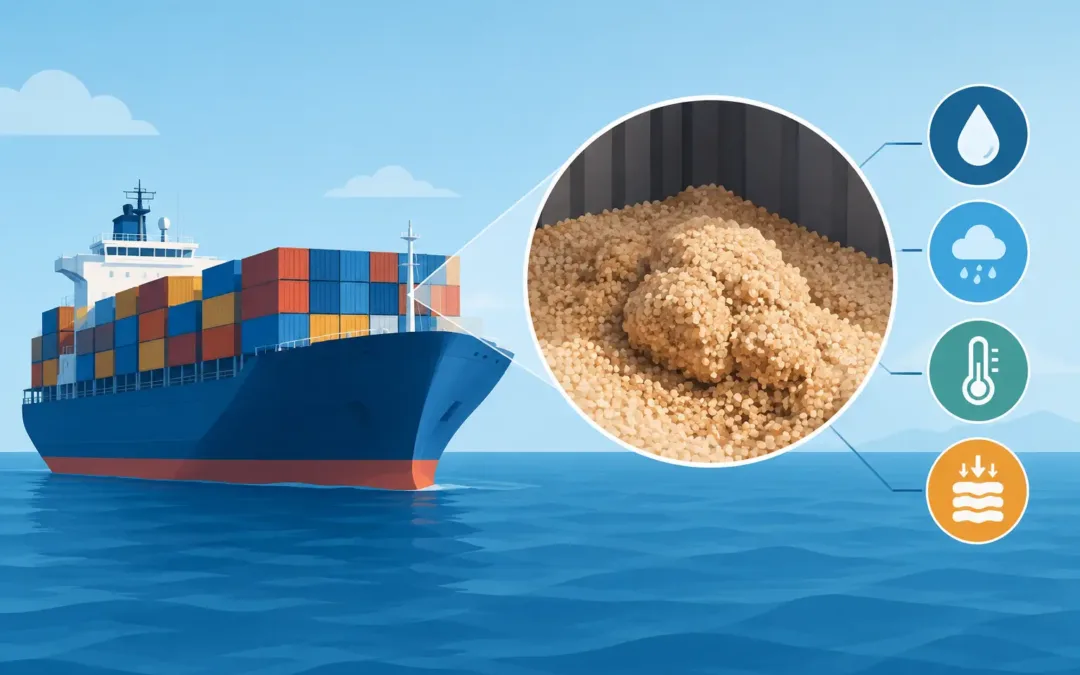
A cargo receiver opens a hold expecting free-flowing product and finds hardened masses, bridged material, or bags fused together. The immediate question is what causes cargo caking, but the defensible answer rarely lies in one event. Caking typically develops through an interaction of cargo properties, moisture exposure, temperature conditions, stowage pressure, and the handling sequence before and during transit.
For charterers, cargo interests, insurers, and terminal operators, the distinction matters. A compacted cargo may still be recoverable through mechanical handling. A chemically altered or moisture-damaged cargo may represent a quality loss, a safety concern, and a substantial claims exposure. Timely, independent condition evidence helps establish whether the issue originated at manufacture, loading, vessel transit, discharge, or shore-side storage.
What Causes Cargo Caking in Bulk and Bagged Cargo?
Cargo caking occurs when individual particles, granules, crystals, or bags bind together and lose their intended flow characteristics. The mechanism may be physical, chemical, or both. Fine powders and hygroscopic materials are especially susceptible, but caking can affect a broad range of commodities, including fertilizers, salt, sugar, cement, mineral concentrates, food ingredients, chemicals, and powdered industrial products.
Moisture is often the primary trigger. When water enters a hygroscopic cargo, the material can absorb it from rain, seawater, condensation, humid air, wet handling equipment, or elevated inherent moisture. A small amount of absorbed water can dissolve particle surfaces. As conditions change and the water redistributes or evaporates, dissolved material recrystallizes at contact points, forming solid bridges between particles. This process is commonly referred to as liquid bridging or crystal bridging.
The source and character of the moisture are significant. Freshwater ingress, seawater contamination, condensation, and cargo moisture can produce different physical conditions and different quality consequences. Seawater may introduce chlorides or other contaminants, while cargo sweat can cause localized wetting in otherwise sound stow. A survey should identify the apparent moisture pattern rather than simply recording that cargo was wet.
Hygroscopicity and Inherent Cargo Properties
Some commodities naturally attract water vapor from the air. Their susceptibility depends on chemical composition, particle surface area, porosity, solubility, moisture content, and the relative humidity at which the cargo begins absorbing moisture. Fertilizer blends, for example, may behave differently from their individual components, particularly where incompatible materials or varying granule sizes are present.
Fine particles create more contact points and a greater surface area for moisture adsorption. They can also migrate into voids between larger particles, reducing airflow and increasing compaction. A cargo with excessive fines may cake even when the overall moisture result appears within a normal specification range.
Product condition before loading is therefore central to causation. Previous storage duration, warehouse humidity, aging, damaged bags, inadequate packaging, or exposure during inland transport can leave cargo vulnerable before it reaches the vessel. An apparent sea-transit problem may begin ashore.
Temperature Changes Create Condensation Risk
Temperature variation can turn ordinary atmospheric moisture into a cargo-damage event. Warm cargo loaded in a humid port and carried into cooler conditions can produce condensation as moist air reaches its dew point. The reverse can also occur when cold cargo encounters warm, moisture-laden air during ventilation or discharge.
In a ship’s hold, this is often described as cargo sweat or ship sweat, although the correct determination depends on the relative temperatures of cargo, air, steelwork, and dew point. Condensation may form on hatch covers, frames, bulkheads, and upper cargo surfaces before dripping or spreading into the stow. The damage pattern may be concentrated beneath structural members, at hatch openings, along hold sides, or near ventilation paths.
Ventilation is not automatically protective. Ventilating with air that has a higher dew point than the cargo or hold environment can introduce moisture rather than remove it. Conversely, keeping holds closed may be appropriate where outside air conditions create a condensation risk. The proper decision depends on measured temperatures and humidity, cargo instructions, vessel capability, and the voyage environment.
Hatch cover integrity is equally important. Leaking compression bars, defective seals, blocked drain channels, damaged cleats, or poorly secured access points can permit water ingress. An Ultrasonic Hatch Cover Survey before loading can identify leakage paths that are not visible during a routine visual inspection.
Pressure, Settlement, and Vibration Can Harden Cargo
Caking is not always a wet-cargo issue. Long periods under pressure can compact certain materials, particularly fine powders and granulated products with a high percentage of fines. Cargo at the bottom of a deep stow bears the weight of the material above it. During a voyage, vessel movement, vibration, and repeated settling can further reduce void spaces and increase interparticle contact.
This form of caking is more likely when cargo is loaded at a high drop height, poorly trimmed, or unevenly distributed. Segregation during loading may leave fines concentrated in certain areas, producing zones with different permeability and compaction behavior. Bagged cargo may also deform or consolidate when stacked beyond packaging limits or exposed to shifting loads.
Pressure alone does not necessarily prove damage. Some commodities naturally settle in transit, and some degree of compaction may be anticipated under the cargo specification or sales contract. The operational question is whether the material remains fit for its intended discharge, processing, and end use. Mechanical breaking, screening, or rehandling may restore flowability, but those measures can create cost, delay, dust, product loss, or contamination issues.
Chemical Reactions and Contamination May Intensify Caking
Certain cargoes cake because of chemical reaction rather than simple moisture absorption. Cement can hydrate when exposed to water. Some fertilizers can react with moisture, generate heat, or undergo changes in physical condition. Oxidation, degradation, or interaction with residues from a prior cargo can also alter product quality.
Contamination is a recurring concern where holds were not properly cleaned, dried, or inspected before loading. Residual cargo, scale, loose rust, oily deposits, cleaning-water residue, or incompatible materials can create localized hardening and quality defects. A pre-loading survey should document hold cleanliness, dryness, coating condition, bilge protection, and readiness against the applicable cargo requirements.
Packaging failures can compound the problem. Torn liners, poorly sealed bags, compromised pallet wrap, and damaged container floors allow water migration and direct cargo-to-cargo contact. The exterior condition of a bag is not always a reliable indicator of the material inside it. Representative sampling and controlled opening may be necessary where a concealed defect is suspected.
How to Establish the Cause of Cargo Caking
A reliable assessment starts before discharge changes the evidence. Once grabs, conveyors, bulldozers, or pneumatic systems break up the cargo, original patterns can be lost. Where caking is reported, parties should preserve the affected areas where practical and arrange an independent cargo condition survey without delay.
The survey record should connect the physical findings to the cargo’s journey. That includes photographs and video of the stow, location mapping within the hold or warehouse, condition of hatch covers and access points, evidence of water tracks or condensation, cargo temperature, ambient temperature and humidity, packaging condition, and the presence of fines, crusting, bridging, or free water.
Documentation should also be reviewed alongside the physical inspection. Relevant records may include loading and discharge tallies, bills of lading, mate’s receipts, certificates of analysis, moisture certificates, ventilation logs, weather records, hatch-cover test results, cargo plans, terminal handling records, notices of protest, and correspondence regarding pre-existing condition. Sampling should follow an agreed protocol with clear identification, custody control, and laboratory instructions appropriate to the commodity.
Causation frequently requires separating several contributing factors. A cargo could have elevated inherent moisture at loading, then experience condensation during transit, followed by delayed discharge and extended storage at destination. Assigning the entire condition to one stage without evidence can create an avoidable commercial dispute. A disciplined survey opinion identifies observations, test results, limitations, and the degree to which each factor is supported by the evidence.
Prevention Begins Before the First Ton Is Loaded
The strongest control point is pre-shipment planning. Cargo interests should confirm the commodity’s moisture limits, hygroscopic behavior, ventilation guidance, packaging requirements, and any manufacturer-specific handling instructions. Vessel interests should verify that holds are clean, dry, odor-free, and suitable; hatch covers are weather-tight; bilges are protected; and the loading plan will avoid unnecessary segregation and compaction.
During loading, attention should remain on weather protection, cargo appearance, fines content, loading rate, drop height, trim, and any signs of wet or hardened material. A Pre-Loading Survey provides a documented benchmark for the cargo and stowage condition. For sensitive cargoes, that benchmark can be decisive if a claim develops after discharge.
When caking is discovered, prompt evidence preservation is more valuable than assumptions. An independent survey can distinguish moisture intrusion from normal settlement, identify the likely stage of exposure, quantify the affected quantity where possible, and provide documentation suitable for cargo, charter-party, insurance, and recovery discussions. Zeus Marine and Cargo Solutions can deploy cargo survey support for condition assessment, sampling coordination, hatch-cover evaluation, and time-sensitive damage documentation when the cargo record must withstand scrutiny.
