
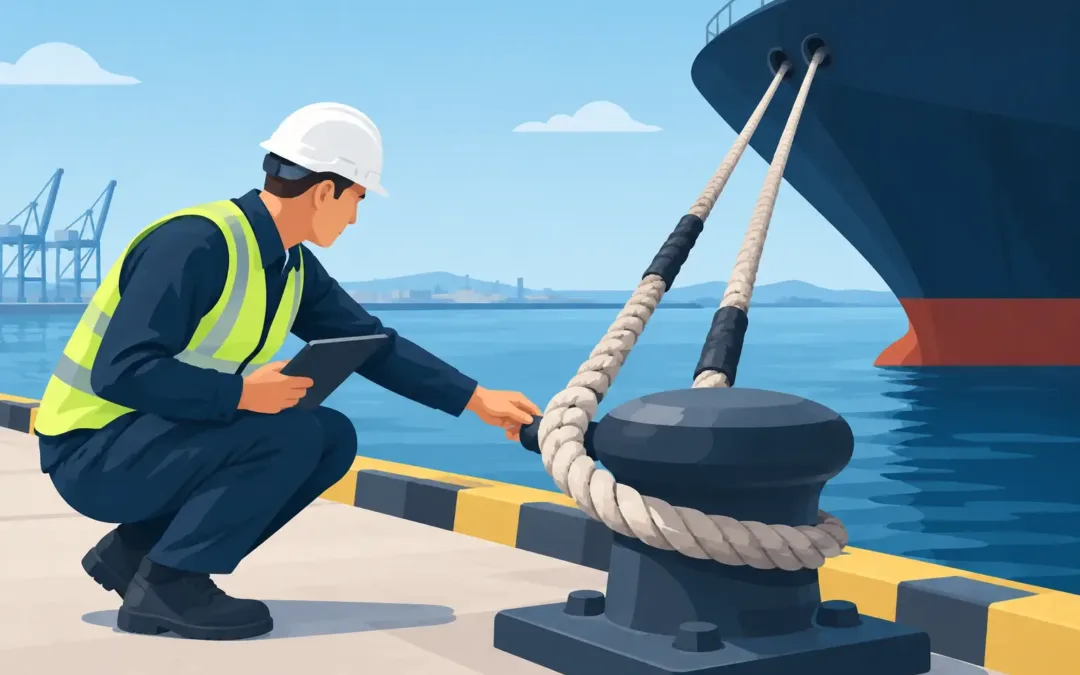
A parted mooring line rarely begins as a sudden event. The exposure usually develops through visible chafe, corrosion at a fitting, poor line lead, uneven load sharing, or a berth arrangement that changes as draft, tide, wind, and cargo operations change. Knowing how to inspect vessel moorings means identifying those conditions before they become a personnel injury, hull contact, terminal damage, or P&I claim.
A meaningful mooring inspection is not limited to walking the deck and confirming that lines appear intact. It is a controlled assessment of the vessel’s mooring system, the berth interface, the operational environment, and the records that demonstrate what was observed. The inspection should establish whether the arrangement is fit for the vessel’s present condition and whether the crew can safely monitor it through the next operational period.
How to Inspect Vessel Moorings: Establish Safe Conditions First
Mooring lines, tails, fittings, and winches operate under stored energy. Before any close examination, confirm that the inspection can be performed outside recognized snap-back zones and without placing personnel between a line and a fixed object. The officer in charge should identify lines under significant tension, recent adjustments, anticipated tide movement, passing traffic, weather changes, and cargo operations that could affect the vessel’s position.
Inspection should be coordinated with the bridge, deck department, terminal representative, and, where appropriate, tug or line-handling personnel. A line that is safe to observe at one stage of tide may become heavily loaded within a short period. Do not rely on a static visual impression when the berth is subject to surge, current, swell, or frequent vessel movements.
The inspection scope must also distinguish between vessel equipment and shore equipment. The vessel operator is responsible for the condition and use of shipboard lines, winches, bitts, chocks, rollers, and fairleads. The terminal or port authority may control bollards, quick-release hooks, dolphins, fenders, and shore mooring arrangements. Document the interface clearly. A damaged shore bollard or an unsuitable lead angle can create vessel exposure even when the ship’s own equipment is in acceptable condition.
Review the Mooring Plan Against Actual Conditions
Start with the approved mooring arrangement or deck plan, then compare it with conditions at the berth. Confirm the number and type of lines deployed, their intended function, and whether the arrangement provides effective restraint ahead, astern, and athwartships. Head lines, stern lines, breast lines, and springs should not be treated as interchangeable. Each has a distinct role in controlling vessel movement.
Check whether the vessel’s present draft, trim, freeboard, and tidal range have altered line leads from the planned arrangement. Excessive vertical angles can overload fittings and reduce the line’s effectiveness. Long lines may be exposed to greater elongation and surge effects, while short leads may experience rapid load changes. Crossing lines, lines led over unsuitable edges, or lines sharing a fairlead in a manner that causes contact and friction require immediate attention.
Load sharing deserves particular scrutiny. One line may appear sound while carrying a disproportionate portion of the load because adjacent lines are slack, poorly tensioned, or affected by winch brake settings. Where fitted and operationally appropriate, line tension monitoring can support the assessment, but it does not replace a physical inspection or competent judgment. Watch the vessel’s movement relative to the berth and observe whether line tension changes predictably as conditions change.
Inspect Lines, Tails, and Connections Closely
The line inspection method depends on whether the vessel uses wire rope, synthetic fiber rope, high-modulus synthetic line, or a mixed arrangement with tails. Each material presents different warning signs and retirement criteria. Follow the manufacturer’s guidance, vessel procedures, and applicable industry standards rather than applying a single visual standard to every line type.
For wire ropes, inspect for broken wires, corrosion, flattening, kinks, birdcaging, crushed sections, damaged splices, and localized wear where the rope passes through chocks or over rollers. Pay particular attention to areas that are regularly hidden on drums or frequently bear against fittings. Internal corrosion may not be obvious from a deck-level visual inspection, especially where lubrication is inadequate or the rope has been exposed to saltwater and contamination.
For synthetic lines and tails, look for abrasion, glazing, cut strands, melted fibers, discoloration, stiffness, flattening, contamination by chemicals or oil, and damage near eyes, splices, and chafe protection. A line can retain a generally acceptable appearance while suffering localized strength loss at a contact point. Remove covers or protective sleeves when practical and safe to inspect the underlying material. Confirm that tails are compatible with the main line and that joining hardware, shackles, or links are correctly fitted and secured.
Record the identification number, construction, diameter, declared minimum breaking load, installation date, and inspection history where those details are available. Traceability matters after an incident. A finding that merely states “line worn” is far less useful than a record identifying the exact line, damage location, degree of deterioration, associated fitting, and operational load condition.
Examine Winches, Brakes, Fairleads, and Deck Fittings
A mooring line is only as reliable as the equipment supporting it. Inspect winch drums for improper spooling, loose wraps, damaged flanges, corrosion, hydraulic leaks, and signs of uneven winding. Confirm that winch brakes, render-and-recover functions, controls, and indicators are maintained in accordance with the vessel’s procedures. Brake holding capacity testing should be supported by documented maintenance records and completed under controlled conditions by qualified personnel.
Inspect bitts, bollards, chocks, Panama chocks, rollers, pedestal fairleads, and foundation welds for cracks, distortion, wastage, corrosion, deformation, sharp edges, and unauthorized repairs. Coating failure around a fitting base can indicate corrosion beneath the surface. Where the condition is uncertain, a more detailed examination may be warranted, including thickness measurement or nondestructive testing.
Fairlead condition is particularly significant. A rough, seized, or damaged roller can create concentrated abrasion and heat in a line that would otherwise be serviceable. Verify that rollers rotate freely where designed to rotate and that line contact surfaces are smooth. Also check that leads remain within the fitting’s intended operating range. Side loading and extreme fleet angles can compromise both the fitting and the line.
Assess the Berth Environment and Dynamic Risks
A sound mooring arrangement can become inadequate when environmental forces exceed the assumptions used during berthing. Assess wind direction and forecast, tidal current, river flow, swell, wake from passing vessels, cargo transfer rates, ballast operations, and the likelihood of draft changes. At exposed terminals, vessel motions caused by surge may be the primary driver of line loading, even in moderate wind conditions.
Fender condition and vessel contact should be reviewed at the same time. Damaged, compressed, or poorly aligned fenders can change the vessel’s stand-off distance and alter line angles. Observe whether the vessel is ranging along the berth, tending away from the dock, or making repeated contact. These movements may indicate that the arrangement requires adjustment, additional lines, tug standby, suspension of transfer operations, or escalation to the terminal and vessel operator.
Do not overlook human factors. Inadequate watchkeeping, unclear communications, fatigue, and unfamiliarity with local berth conditions often turn a manageable mooring issue into an incident. The mooring watch should understand who has authority to adjust lines, when to call the master, and which environmental triggers require action.
Document Findings for Operational and Claims Use
A defensible mooring inspection record should connect each finding to a location, condition, risk level, and required action. Clear photographs should show both the close-up defect and its position within the overall arrangement. Include date, time, vessel condition, berth location, weather, tide or river stage where relevant, and the status of cargo or ballast operations.
For significant deficiencies, specify whether the condition requires immediate isolation, line replacement, equipment repair, increased monitoring, operational restriction, or a follow-up survey. Avoid vague recommendations such as “monitor closely” unless the inspection record defines who will monitor, what will be monitored, and the trigger for escalation.
Independent survey evidence is especially valuable where a line failure, berth contact, cargo interruption, or liability dispute is possible. The report should separate observed facts from operational opinions and identify any limitations, such as inaccessible areas, restricted visibility, or equipment that could not be function-tested.
When a Mooring Condition Requires Immediate Escalation
Immediate action is warranted when there is a damaged or overloaded line, a cracked or deformed fitting, a line leading over a sharp edge, uncontrolled vessel movement, a failed winch or brake, or an environmental condition beyond the berth’s operating limits. The appropriate response depends on the situation. It may involve stopping cargo operations, adjusting the arrangement, replacing equipment, requesting tug assistance, shifting berth, or suspending the operation until the risk is controlled.
The objective is not to produce a fault-free inspection form. It is to give the master, terminal, operator, insurer, and other interested parties a clear basis for safe decisions. A disciplined inspection performed before the lines are tested by changing conditions is one of the most practical forms of marine risk control.
