
An emergency drill is not a demonstration for a checklist. It is the only controlled opportunity to test whether a vessel can protect people, preserve command, and limit damage when normal operations fail. This guide to shipboard emergency drills addresses the practical controls that turn a scheduled exercise into credible evidence of crew readiness.
For owners, operators, charterers, insurers, and P&I interests, drill quality also carries a commercial consequence. A weak drill can expose gaps in maintenance, manning, communication, and Safety Management System implementation long before those deficiencies appear in a casualty, port state control inspection, or claims file.
What Effective Emergency Drills Are Designed to Test
A drill should validate a response system, not merely confirm that equipment can be displayed. The scenario must test how the crew receives an alarm, reports to assigned stations, establishes command, communicates across departments, deploys equipment, accounts for personnel, and records critical decisions.
The applicable drill program is shaped by SOLAS requirements, flag-state rules, class recommendations, vessel type, trade, company procedures, and the vessel’s approved Safety Management System. Tankers, bulk carriers, container vessels, offshore units, and passenger vessels each carry different operational risks. A generic exercise may satisfy a calendar requirement while failing to address the vessel’s actual exposure.
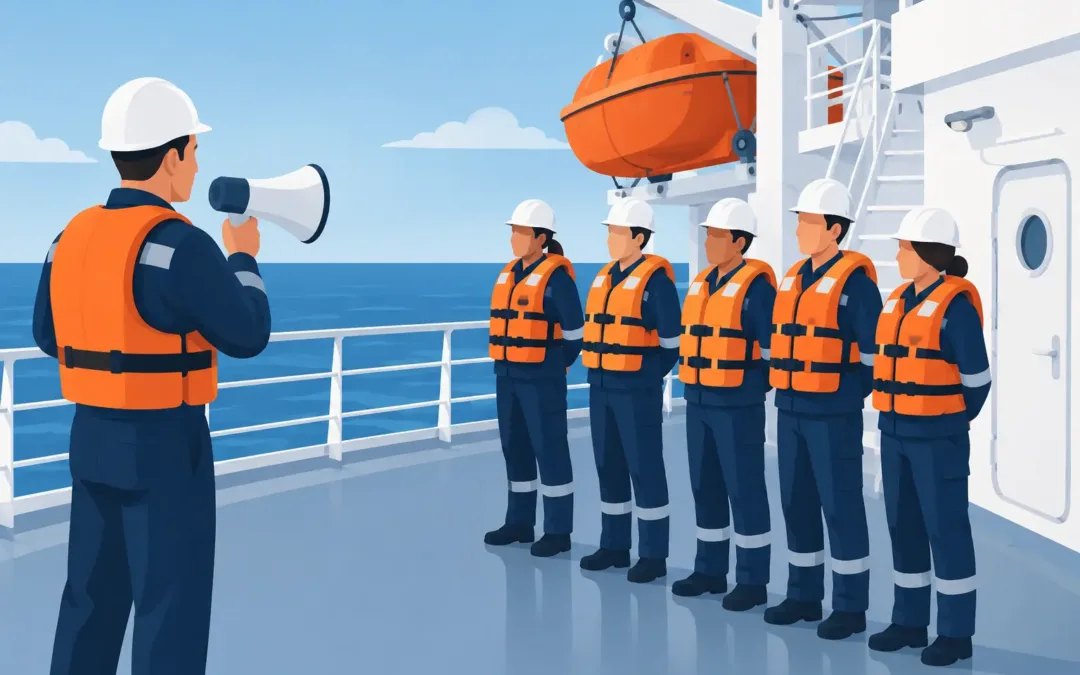
A fire drill in an engine-room boundary, for example, should test breathing apparatus control, ventilation closures, fire pump performance, machinery-space isolation, and communication between the bridge and the emergency team. An abandon-ship exercise should examine muster discipline, survival craft preparation, embarkation arrangements, radio procedures, and the practical condition of launching equipment. The objective is not speed alone. It is controlled, correct execution under realistic constraints.
Planning a Shipboard Emergency Drill
Good drills begin before the alarm is sounded. The master and designated safety officers should establish the exercise objective, scenario boundaries, expected actions, observers, and stop-work criteria. A drill must never create a second emergency through unsafe boat handling, uncontrolled equipment operation, exposure to enclosed spaces, or inadequate supervision.
The scenario should be specific enough to force decisions. “Fire drill” is too broad. “Simulated galley fire spreading through an adjacent accommodation boundary, with one missing crewmember” creates identifiable tasks and allows performance to be measured. Similarly, a simulated flooding event should state the compartment involved, the assumed source, the expected stability concern, and whether damage control communications are functioning.
Pre-drill planning should confirm the condition and availability of relevant equipment. This includes portable radios, fixed firefighting systems where testing is appropriate, fire hoses and nozzles, breathing apparatus, emergency escape breathing devices, first-aid resources, emergency lighting, watertight doors, bilge arrangements, survival craft equipment, and personal protective equipment. Equipment defects discovered during preparation should be entered into the defect-management process, not concealed to preserve the appearance of readiness.
Drills can be announced or limited-notice, depending on the company program and operational conditions. Announced drills are useful for training unfamiliar crew or introducing a new procedure. Limited-notice exercises more accurately reveal response habits and communication gaps. Neither format is sufficient on its own. A mature program uses both while ensuring personnel are not placed at avoidable risk.
Match the Scenario to Current Vessel Risk
The strongest drill schedules reflect recent operations and known exposures. Following cargo work, consider a scenario involving hot work controls, hazardous atmosphere concerns, or cargo-area fire response. After crew changes, focus on muster roles, familiarization, and command continuity. Before heavy-weather transits, conduct exercises involving flooding response, emergency steering, or loss of propulsion.
Cargo characteristics matter. Vessels carrying bulk commodities, dangerous goods, refrigerated cargoes, project cargo, or unitized containers may require scenarios that test the specific hazards documented in cargo declarations, stowage plans, and emergency response information. The drill should reinforce the operational link between cargo integrity and crew safety.
Conducting the Drill With Discipline
At the start of the exercise, activate the relevant alarm and initiate the communication sequence required by the vessel’s emergency procedures. The bridge team must maintain safe navigation and watchkeeping throughout. A drill does not remove the need to manage traffic, pilotage, cargo operations, weather, or port restrictions.
Muster lists should be treated as working documents. Observers should verify whether crewmembers report to the correct station with suitable protective equipment, whether personnel are accounted for accurately, and whether substitutions are clear when assigned personnel are unavailable. Confusion around a single critical role, such as boundary cooling, communications, damage control, or survival craft command, is a material finding rather than a minor inconvenience.
Command structure is equally important. The master retains overall authority, but emergency teams need clear tasking and reliable reporting lines. Messages should identify the source, location, condition, action taken, and support required. Vague radio traffic such as “fire team on scene” provides little operational value. A meaningful report states the affected compartment, apparent fire class or hazard, personnel status, boundaries established, and whether additional resources are needed.
Observers should avoid coaching during the exercise unless an unsafe condition develops. If personnel are continuously prompted, the record will measure the observer’s knowledge rather than the crew’s readiness. Notes should capture actual times, communications, equipment issues, procedural deviations, and any actions that were delayed or omitted.
Common Deficiencies Found During Emergency Drills
Many shortcomings are not caused by a lack of effort. They develop because equipment inspections, familiarization, maintenance, and operational planning have become disconnected from the drill program. Several deficiencies repeatedly deserve close attention:
- Incomplete mustering or inaccurate personnel accountability, particularly after crew changes or during contractors’ attendance.
- Portable radio failures, unclear emergency channels, poor message discipline, or no communication between the bridge and response teams.
- Breathing apparatus that is not ready for immediate use, with missing cylinders, expired inspections, poor mask fit, or inadequate wearer checks.
- Fire stations, hydrants, hoses, dampers, remote stops, watertight closures, or emergency generators that cannot be operated as required.
- Survival craft and launching arrangements that are difficult to prepare because of maintenance shortcomings, unfamiliarity, or poor coordination.
- Drill records that only state “completed satisfactorily” and provide no basis for corrective action or later verification.
The right response is not to assign blame after the event. It is to identify the underlying condition. A missed muster may point to an outdated station bill. A delayed hose deployment may indicate poor stowage, degraded equipment, or an inadequate training method. Corrective action must address the cause, assign responsibility, set a due date, and verify closure.
Documentation That Withstands Scrutiny
Emergency drill records are operational evidence. They may be reviewed during flag-state inspections, port state control examinations, ISM audits, pre-vetting inspections, P&I condition surveys, casualty investigations, and insurance claims. A record that lacks detail can create doubt about whether the drill was conducted effectively.
The drill entry should identify the date, time, location, type of drill, scenario, personnel participating, equipment used, key timings, deficiencies observed, corrective actions, responsible persons, and completion status. Supporting photographs, maintenance references, training records, and observer notes may be appropriate where company procedures permit. Documentation should remain factual. It should distinguish simulated conditions from actual equipment failures and avoid unsupported statements of compliance.
For higher-risk vessels or operations, an independent review can add value. A focused HSEQ maritime audit or vessel safety inspection can compare drill practice against the SMS, statutory requirements, equipment condition, and the vessel’s real operational risk profile. This is particularly useful before a change in trade, following a detention or incident, or when insurers and commercial stakeholders require defensible assurance.
Debrief While the Details Are Still Useful
The debrief should occur promptly after the vessel is returned to a safe operating condition. Ask the crew what information was missing, where communications failed, whether equipment was accessible, and which instructions were unclear. Crewmembers closest to the response often identify practical issues that are not visible from the bridge or an observation position.
Keep the discussion focused on actions and conditions. The purpose is to improve the next response, not to produce a polished narrative. Where an issue cannot be corrected on board, escalate it through the company reporting process with sufficient technical detail for shore management to act.
An effective emergency drill leaves the vessel better prepared than it was before the alarm. When planning, execution, evidence, and corrective action are handled with equal discipline, the drill becomes a credible control against injury, pollution, cargo loss, vessel damage, and avoidable claims.
