
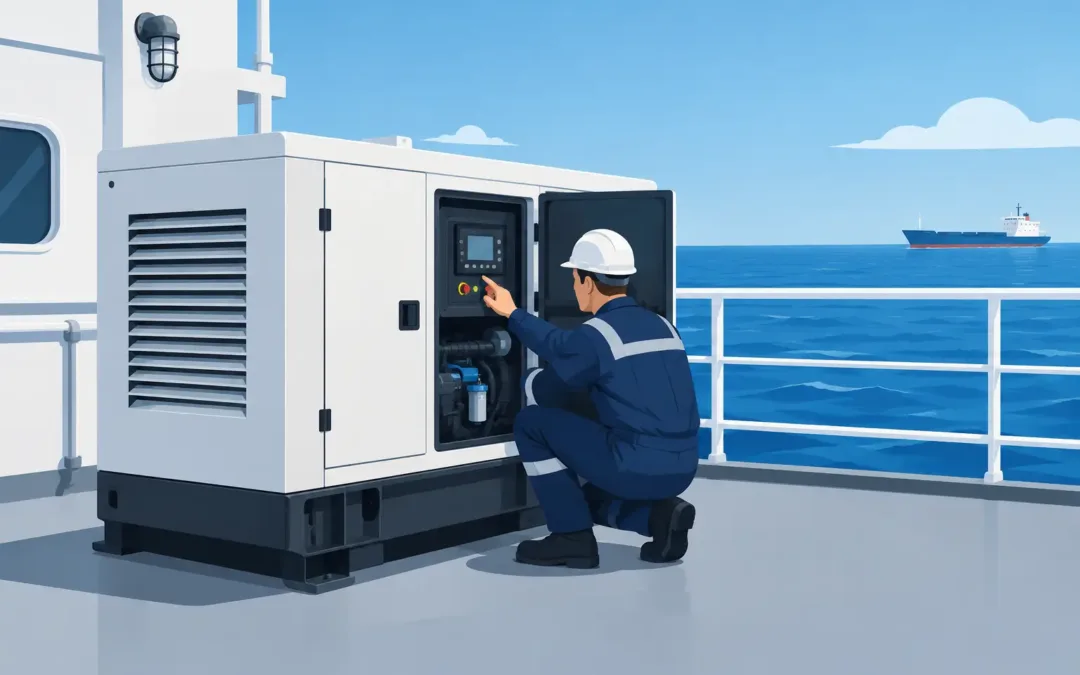
An emergency generator is not proven by a clean engine-room inspection or a successful no-load start. It is proven when normal power is unavailable, the emergency source starts as intended, essential services are restored within the required time, and the vessel’s records show exactly what occurred. For owners, operators, charterers, and insurers, knowing how to test emergency generators is therefore a matter of seaworthiness, statutory compliance, and defensible risk control.
A meaningful test must verify the complete emergency power arrangement: the generator, its starting system, emergency switchboard, automatic transfer functions, protective devices, connected loads, alarms, and operating records. The scope and frequency should always follow the vessel’s Safety Management System, flag-state rules, class requirements, manufacturer instructions, and applicable statutory requirements.
Start With Test Planning and Risk Controls
Emergency generator testing affects live electrical systems. Poorly controlled testing can interrupt navigation equipment, communications, cargo operations, machinery alarms, or shore connections. Before initiating a test, the responsible officer should establish what equipment will be affected, whether the vessel is underway or alongside, and whether any operation makes a simulated blackout unsuitable.
Notify the master, chief engineer, officer of the watch, bridge team, engine room watchkeepers, terminal or port representatives when applicable, and any contractors working on affected electrical systems. If the vessel is cargo handling, bunkering, maneuvering, conducting critical maintenance, or connected to shore power, the test may need to be postponed or performed under a more limited procedure.
The pre-test review should confirm that the emergency generator compartment is accessible, adequately ventilated, and free of oil leakage, loose materials, or temporary obstructions. Verify fuel availability, lubricating oil level, cooling-water arrangements, battery condition, charger status, starting-air pressure where fitted, and the condition of exhaust and insulation components. A generator that starts during a test but has inadequate fuel or cooling endurance has not demonstrated emergency readiness.
Review prior defect reports and maintenance history before testing. Repeated battery-charger alarms, slow cranking, unstable frequency, fuel contamination, or automatic-breaker failures are not minor observations. They are indicators that the emergency source may fail when a genuine blackout occurs.
How to Test Emergency Generators: Verify the Full Sequence
The test should be conducted as a controlled sequence, not simply as an engine start. The exact arrangement differs by vessel, but the objective remains consistent: loss of the main electrical supply should initiate the emergency generator, connect it to the emergency switchboard, and restore required emergency services without improper back-feeding or unsafe switching.
Inspect the Generator Before Starting
Begin with a physical inspection. Check for fuel, lubricating oil, cooling water, exhaust leakage, damaged wiring, deteriorated mounts, loose terminal connections, corrosion, and signs of overheating. Inspect the local control panel for active fault indications, disabled alarms, or selector switches left in manual or test positions.
Confirm that the generator’s automatic-start arrangement is selected correctly. Many failures occur because a unit has been left in local/manual control after maintenance. Also verify that remote stop arrangements, emergency stop devices, and protective trips are not inadvertently engaged.
Battery condition deserves close attention. Inspect battery terminals for cleanliness and tightness, verify electrolyte condition where applicable, and confirm charging voltage. Weak batteries are among the most common causes of emergency-generator failure, particularly on vessels where the unit runs infrequently or operates in high-temperature spaces.
Conduct a Manual Start Test
A manual start verifies basic mechanical and electrical condition before a more consequential automatic transfer test. Start the set locally in accordance with the manufacturer’s procedure and observe oil pressure rise, cooling-water flow, charging performance, voltage, frequency, engine speed, exhaust condition, and abnormal vibration.
Allow the unit to stabilize before applying load. Check that voltage and frequency remain within the vessel’s defined operating limits. Unstable frequency can damage connected equipment or prevent reliable operation of communication, monitoring, and emergency lighting circuits.
A no-load run is useful, but it is not sufficient. A generator can sound normal without being capable of carrying its assigned emergency load. The next stage must confirm performance under a realistic electrical demand.
Simulate Loss of Main Power
Where the vessel’s approved procedure permits, simulate the loss of normal electrical supply to the emergency switchboard. This is the critical functional test. Observe whether the emergency generator starts automatically and whether the emergency breaker closes correctly after voltage and frequency have stabilized.
Record the actual time from loss of supply to generator start and connection. The target time depends on vessel design and regulatory requirements, but the key operational question is whether the required emergency services are restored within the prescribed period.
During transfer, verify that the main source is disconnected from the emergency switchboard as designed. The system must prevent parallel operation or back-feeding unless the installation is specifically engineered and approved for that mode. Incorrect interlocking can create severe electrical hazards and may damage generators, switchgear, or connected equipment.
Confirm Essential Loads and Alarms
Once the emergency generator is connected, verify the services assigned to the emergency switchboard. Depending on vessel type and equipment configuration, this can include emergency lighting, navigation lights, internal communications, general alarm, fire detection, public address, bridge electronics, radio equipment, steering-gear control power, watertight-door controls, fire pump support systems, and machinery monitoring.
Do not assume that illuminated panel lamps prove the circuits are functional. Walk down representative areas and confirm that emergency lights operate, communications are intelligible, alarm signals are received, and bridge indications remain available. On vessels with complex integrated systems, coordinate the checks with responsible officers so that temporary loss of redundant displays or alarms is understood and controlled.
Observe generator loading throughout the test. A light load may not expose problems with governor response, voltage regulation, cooling, fuel supply, or breaker performance. Where feasible and safe, apply a controlled load representative of the emergency demand. A load-bank test may be appropriate when operational loads cannot provide an adequate test, especially after major repair, extended layup, or repeated poor performance.
Check Safety Functions Without Creating New Risk
Protection systems are part of the emergency-generator arrangement, but they must be tested in accordance with the manufacturer’s instructions and vessel procedures. This can include low lubricating-oil-pressure alarms, high cooling-water-temperature alarms, overspeed protection, battery-charger failure alarms, low fuel alarms, insulation monitoring, and generator fault indications.
There is a practical trade-off. Intentionally tripping a protective device can demonstrate that it operates, but an uncontrolled trip during a transfer test may create unnecessary disruption or leave the vessel without the intended emergency supply. Test methods should be selected based on operational condition, equipment design, and the competence of personnel conducting the work.
Emergency fuel arrangements require separate attention. Verify that the dedicated fuel tank, quick-closing valves, fuel lines, filters, and ventilation are in serviceable condition. If the generator relies on a day tank or transfer arrangement, confirm it has sufficient capacity for the required endurance and that its supply cannot be compromised by the same casualty that disables the main generators.
Restore the System and Record the Evidence
At the end of the test, return all selectors, breakers, and control modes to their normal operating position. Confirm that the main supply has been restored correctly, the emergency generator has completed any required cool-down period, and no alarms or defects remain active. A frequent post-test error is leaving the unit in manual mode, which defeats automatic starting during an actual blackout.
The test record should state the date, location, vessel operating condition, personnel involved, test method, start and transfer times, voltage and frequency readings, load observed, emergency services verified, alarms tested, defects found, and corrective actions initiated. Photographs of instruments, alarm panels, and switchboard status can strengthen the evidentiary value of the record when a survey, casualty investigation, vetting review, or insurance claim later examines readiness.
If a defect is identified, describe it precisely. “Emergency generator tested unsatisfactory” is not an adequate finding. Record whether the failure involved starting batteries, fuel supply, automatic transfer, breaker closure, voltage regulation, connected circuits, or alarm functionality. State the interim risk controls, responsible party, repair deadline, and requirement for retest.
When an Independent Verification Adds Value
An independent electrical or vessel-condition survey can be appropriate after a blackout, machinery casualty, purchase inspection, extended inactivity, class recommendation, insurer request, or recurring deficiency. The purpose is not merely to witness a run test. It is to determine whether the emergency-power system is operationally reliable, correctly maintained, and supported by records that withstand commercial and claims scrutiny.
For charterers and cargo interests, emergency-generator condition can affect more than statutory compliance. A loss of emergency power can delay cargo operations, compromise refrigerated cargo, impair fire safety, and create operational disputes. For insurers and P&I interests, clear test evidence helps distinguish a maintained, ready system from a foreseeable equipment failure.
The most useful test result is not a signed logbook entry. It is a verified operating sequence, accurate readings, identified deficiencies, and a corrective path that leaves the vessel ready for the next loss of main power – whenever it occurs.
