
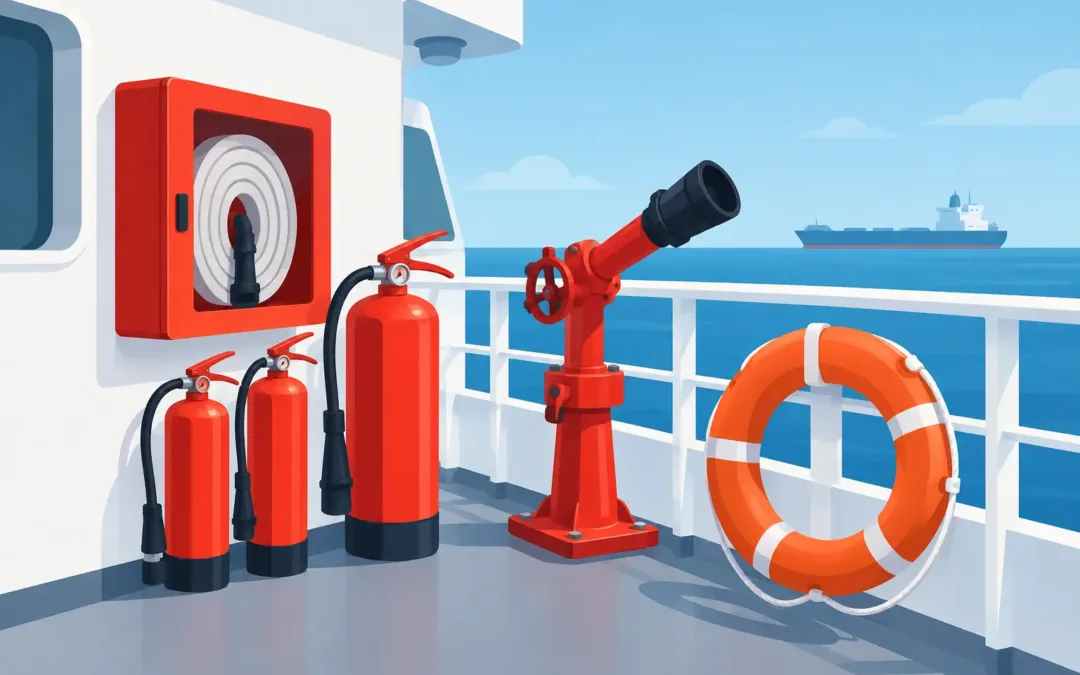
A fire on board does not allow time to compensate for poor equipment selection, incomplete maintenance records, or an inaccessible extinguisher. The best shipboard fire equipment is not a single product package. It is an integrated, vessel-specific system that detects fire early, limits its spread, protects evacuation routes, and gives trained crew the correct means to respond without creating a larger casualty.
For owners, operators, charterers, insurers, and P&I interests, the question is not simply whether required equipment is on board. The operational question is whether the equipment is correctly specified, available at the point of need, maintained to a verifiable standard, and supported by crew competence. A fire safety inspection should test all four conditions.
What Makes Shipboard Fire Equipment Effective
Shipboard fire protection must account for the vessel’s construction, trade, machinery arrangement, cargoes, fuel type, crew size, and operational profile. A container vessel carrying dangerous goods, an offshore support vessel with extensive machinery spaces, and a bulk carrier on a long ocean passage do not present identical fire risks.
The most effective arrangements follow the basic fire-protection sequence: prevent ignition, detect fire, contain the affected space, suppress the fire with an appropriate agent, and protect personnel during evacuation and response. Failure in any one layer can increase the significance of the next.
Compliance with SOLAS requirements, flag-state rules, classification society requirements, and the Fire Safety Systems Code establishes the baseline. However, minimum compliance does not always resolve practical deficiencies. During vessel condition surveys, recurring concerns include blocked fire stations, deteriorated hoses, missing nozzle settings, inoperative fire doors, incorrect extinguisher locations, and records that do not match the equipment physically on board.
Detection and Alarm Systems
Early warning preserves options. Fixed fire detection and alarm systems should provide dependable coverage in accommodation spaces, machinery spaces, control stations, cargo spaces where required, and other protected areas identified by the vessel’s fire control plan.
Smoke, heat, and flame detectors each have appropriate applications. Smoke detection is often suited to accommodation and enclosed service spaces, while heat detection may be more suitable where machinery-space conditions could cause nuisance alarms. Flame detection can be critical in specific high-risk machinery or fuel-handling locations, but its effectiveness depends on detector positioning and a clear field of view.
Detection equipment should not be assessed only through a panel test. Surveyors should verify that detectors are physically intact, free from inappropriate paint or contamination, correctly identified, and not obstructed by later modifications. Alarm audibility, visual indicators, manual call points, and communication to the bridge or continuously manned control station must also be considered. An alarm that cannot be heard or promptly interpreted does not deliver meaningful protection.
Fixed Firefighting Systems for High-Risk Spaces
Fixed suppression systems are central to machinery-space and cargo-space protection because a developing fire may become inaccessible before portable extinguishers can be safely deployed. The correct system depends on the hazard and the protected volume.
Carbon dioxide systems remain common for machinery spaces and certain cargo holds. They can be highly effective when the space is properly sealed and the release sequence is controlled. Their principal trade-off is life safety: personnel must be accounted for and evacuated before discharge. Release cabinets, pilot arrangements, warning alarms, operating instructions, and room-sealing condition all require close inspection.
Water mist systems can provide rapid cooling with reduced water demand and may be used in machinery spaces, accommodation areas, and special-category spaces, depending on the approved design. Their performance relies on pump readiness, nozzle condition, valve alignment, and the integrity of the distribution network. A system that has been isolated for maintenance and not restored creates a material exposure.
Foam systems are particularly relevant where flammable liquid hazards exist, including deck foam arrangements on tankers and foam protection for selected machinery or cargo-related risks. Foam concentrate condition, proportioning accuracy, concentrate type, and compatibility with the protected hazard matter as much as the presence of tanks and monitors. Expired, degraded, or mismatched foam concentrate can compromise a response when it is most needed.
For galley ranges and deep-fat fryers, fixed wet-chemical systems are generally the appropriate choice. These systems should be coordinated with fuel and electrical shutoffs, ventilation controls, and clearly understood manual activation procedures.
Cargo-space protection requires cargo knowledge
No fixed system can be evaluated in isolation from the cargo. For bulk cargoes, containerized dangerous goods, vehicles, or project cargo, the fire strategy should reflect the cargo declaration, stowage plan, segregation requirements, and available firefighting media. Water may be appropriate for cooling boundaries but unsuitable for particular cargoes or energized equipment. Incorrect assumptions at the planning stage can turn a routine incident into a cargo claim, structural loss, or crew-safety event.
Portable Equipment and First-Response Readiness
Portable extinguishers are often the first equipment brought to an incipient fire. Their value depends on selecting the correct extinguishing medium and locating units where crews can reach them without entering a hazardous area.
Dry chemical powder extinguishers are versatile and effective for many flammable liquid and gas fires, but powder can reduce visibility, contaminate sensitive machinery, and complicate cleanup. Carbon dioxide extinguishers are useful for electrical equipment and small flammable liquid fires, though they provide limited cooling and carry an asphyxiation risk in confined spaces. Foam extinguishers can be effective on suitable Class B liquid fires, while water or water-mist units may support ordinary combustible fire response where electrical and reactive-material risks are controlled.
A credible inspection verifies more than the inspection tag. Extinguishers should be of approved type and capacity, securely mounted, accessible, sealed where applicable, within service interval, properly pressurized, and marked for the protected area. The associated signage must remain visible under emergency conditions. Equipment hidden behind stores, lashings, spare parts, or temporary gear should be treated as unavailable.
Fire hoses, hydrants, branch pipes, international shore connections, and portable foam applicators require the same discipline. Hose deterioration, damaged couplings, seized hydrant valves, and missing spanners are common defects that can remain unnoticed until a drill or emergency exposes them.
Firefighter Equipment and Safe Entry
The best shipboard fire equipment also protects the people expected to use it. Firefighter outfits should include the required protective clothing, boots, gloves, helmets, lamps, axes, lifelines, breathing apparatus, and communication capability appropriate to the vessel’s approved arrangement.
Self-contained breathing apparatus deserves particular scrutiny. Cylinder pressure, hydrostatic test status, face-mask condition, demand-valve performance, spare-cylinder availability, compressor maintenance, and escape-set arrangements all influence whether an entry team can safely operate. Crews must be able to don equipment quickly, communicate with boundary teams, monitor air supply, and withdraw before conditions become untenable.
Thermal imaging cameras can improve search, assessment, and boundary-cooling decisions, particularly in smoke-filled accommodation or machinery spaces. They are valuable tools, not substitutes for training. Poor interpretation of thermal images can lead to incorrect assumptions about fire location, hidden hot spots, or structural conditions.
Inspection Priorities That Stand Up to Scrutiny
Fire safety equipment should be assessed against the vessel’s approved plans, equipment inventory, maintenance system, and operating reality. A focused fire safety survey typically examines physical condition, accessibility, testing evidence, service certificates, crew familiarity, and the relationship between equipment and identifiable hazards.
Particular attention should be given to fire doors, dampers, remote fuel shutoffs, emergency stops, ventilation closures, fire pumps, emergency fire pumps, fixed-system release stations, escape routes, and emergency lighting. These elements are sometimes treated as separate maintenance items, but they function together during an actual fire.
Drills provide useful evidence when they are realistic. A drill that begins with equipment already staged and personnel already assigned may satisfy a schedule without testing response readiness. More useful exercises require crews to identify the correct station, establish communications, account for personnel, prepare boundary cooling, and make decisions based on a simulated fire location and type.
Independent inspection is especially valuable before a sale, charter, port-state inspection, insurance review, or anticipated high-risk voyage. Zeus Marine and Cargo Solutions can support vessel-condition, safety, and HSEQ inspections where documented findings, equipment verification, and timely risk identification are required.
The right equipment is the equipment that matches the vessel’s hazards and performs when the crew reaches for it. Treat fire protection as a working operational system, verify it before the next voyage, and correct small deficiencies before they become the first link in a major casualty.
