
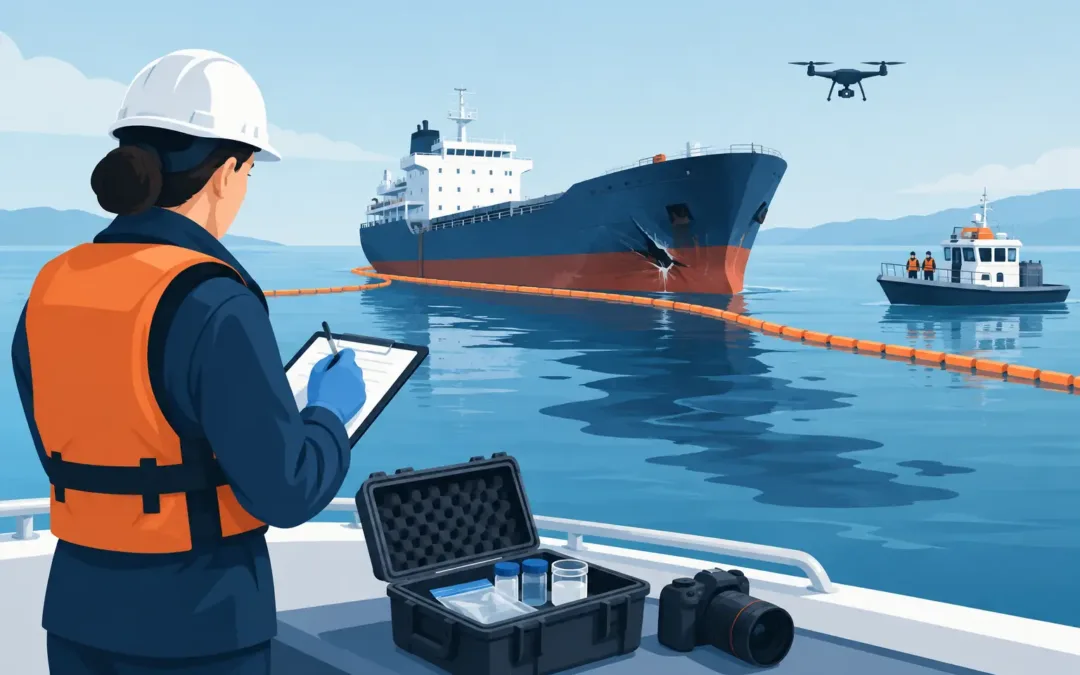
A marine casualty rarely allows time for a perfect response plan. A grounding, collision, cargo shift, machinery failure, water ingress, fire, contamination event, or disputed shortage can develop into a significant commercial exposure before all parties are even notified. Effective marine casualty response begins with disciplined control of the scene, preservation of evidence, and independent technical assessment while facts are still available.
For owners, charterers, cargo interests, insurers, P&I clubs, terminals, and claims teams, the early objective is not to assign blame. It is to establish what happened, what remains at risk, and what actions are necessary to protect life, property, cargo, the environment, and the evidentiary record.
What Marine Casualty Response Must Accomplish
A casualty response has operational and claims consequences at the same time. The vessel may need to continue safely, cargo may require segregation or mitigation, and port or regulatory authorities may require prompt notifications and documentation. Meanwhile, the commercial parties need reliable facts before arranging repairs, declaring cargo a total loss, accepting a shortage claim, or pursuing recovery against another party.
The quality of the first survey work often determines whether later decisions are defensible. A report prepared after cargo has been moved, damaged packaging discarded, holds cleaned, or repairs completed may be useful, but it cannot replace contemporaneous evidence. Time-stamped observations, photographs, measurements, samples, statements, and records should connect the casualty condition to a clear chain of custody.
The scope depends on the incident. A wet cargo claim may require hatch-cover testing, hold-condition inspection, moisture mapping, sampling, and review of ventilation and weather records. A collision or allision may require damage mapping, machinery and bridge record review, draft verification, and preservation of electronic data. A bunker dispute may call for tank soundings, representative samples, seal verification, and reconciliation against delivery records.
The First Hours: Stabilize, Preserve, Notify
The master and vessel operator retain responsibility for emergency action, crew safety, navigation, pollution prevention, and statutory reporting. The attending surveyor’s role is different but closely aligned: independently record conditions, identify immediate risks to cargo or vessel interests, and help ensure that evidence is not unintentionally lost during recovery operations.
A practical response starts by establishing the casualty timeline. When was the event first detected? What was the vessel’s position, draft, cargo status, weather condition, speed, operational mode, and watch arrangement? What actions were taken, by whom, and in what order? Small gaps in timing can become material where seawater ingress, temperature excursion, cargo heating, contamination, or alleged delay is involved.
Preservation should be proportionate to the exposure. In a high-value cargo loss or serious structural incident, that may mean securing damaged components, retaining failed parts, preserving electronic records, taking joint samples, and documenting seals before access or discharge begins. In a lower-value event, a focused survey and accurate photographic record may be sufficient. The point is not to create paperwork for its own sake. It is to retain the facts needed for sound operational and claims decisions.
Independent Attendance Protects the Record
Shipboard personnel, terminal teams, and cargo representatives frequently act under intense operational pressure. Their records are essential, but they are not a substitute for independent survey evidence. An experienced casualty surveyor can distinguish between observed facts, reported information, and technical opinion, which helps prevent assumptions from hardening into the claim narrative.
Independence is especially valuable when interests are misaligned. Cargo receivers may allege pre-existing damage. Carriers may contend that packaging was inadequate. A terminal may dispute whether damage occurred during discharge. Insurers may need to determine whether mitigation was reasonable. A clear condition survey, supported by measurements and photographs, gives all parties a common factual starting point.
Joint surveys can be effective when coordinated properly. They reduce duplicate attendance and allow stakeholders to observe key findings directly. However, joint attendance does not eliminate the need for each party to protect its own position. Survey instructions should define the purpose of attendance, the items to be examined, sampling protocols, access requirements, and whether destructive testing or disposal is contemplated.
Marine Casualty Response for Cargo Incidents
Cargo casualties require more than a statement that goods were wet, crushed, contaminated, or short landed. The survey should identify the cargo condition, quantity affected, probable mechanism of damage, extent of mitigation, and relationship between the observed condition and the transport cycle.
For breakbulk, project cargo, steel, bagged commodities, forest products, and packaged goods, that may include an examination of stowage, lashing, dunnage, packaging integrity, hatch condition, discharge methods, and segregation. For bulk cargoes, draft survey data, shore scale records, tally information, hold cleanliness, sampling, and reconciliation of loading and discharge figures may be central. For temperature-sensitive cargo, temperature logs, reefer settings, power continuity, air circulation, and product-core readings can be decisive.
Mitigation must be documented as carefully as the damage. Reconditioning, segregation, drying, salvage sale, rebagging, transfer to cold storage, or controlled discharge can reduce the final loss. But if the condition before and after mitigation is not recorded, the parties may later struggle to establish what loss was actually avoided and at what cost.
Vessel Damage, Machinery Failures, and Port Incidents
Vessel casualties demand a structured examination of both damage and causation indicators. Hull damage should be mapped with location references, dimensions, deformation patterns, coating condition, signs of fresh contact, and any associated water ingress. Machinery incidents require attention to alarms, operating parameters, maintenance history, lubricants, failed components, and the sequence of shutdown or emergency response.
Not every incident calls for an immediate causation opinion. Premature conclusions can create unnecessary disputes, particularly where class, flag, underwriters, legal counsel, or regulatory investigators remain involved. The more defensible approach is to separate immediate observations from findings that require further document review, laboratory testing, engineering analysis, or access to additional evidence.
Port and terminal incidents add another layer of complexity. Crane contact, berth damage, line failure, cargo-handling damage, and loading interruptions may involve vessel, terminal, stevedore, pilotage, and towage interests. Early documentation of berth conditions, fendering, gangway arrangements, mooring configuration, equipment identification, weather, and personnel accounts can materially affect later allocation of responsibility.
Documentation That Withstands Scrutiny
A casualty report must be useful to operations personnel and credible to claims handlers, insurers, and counsel. That means it should be precise without overstating what the evidence proves. Photographs need captions, orientation, dates, and a clear connection to the item described. Measurements should state the method and equipment used. Samples should identify the source, date, seal number, handling history, and laboratory instructions.
The report should also identify limitations. Restricted access, unsafe conditions, missing records, disputed quantities, altered cargo condition, or an inability to inspect concealed areas are not minor footnotes. They define the reliability and scope of the findings. Transparent limitations increase the value of the report because they allow decision-makers to understand where further investigation may be required.
Digital records deserve the same discipline as physical evidence. Voyage data, engine logs, electronic charts, CCTV footage, terminal systems, reefer monitoring data, and email instructions can be overwritten or become inaccessible. Preservation requests should be made early, and copies should be retained in a controlled manner consistent with the parties’ procedures and legal requirements.
Choosing the Right Response Scope
A full casualty investigation is not always necessary. The proper scope depends on safety consequences, cargo value, potential environmental exposure, vessel condition, contractual requirements, jurisdiction, and the likelihood of a disputed claim. Over-investigating a minor packaging claim can add cost without improving the outcome. Under-investigating a casualty involving a high-value commodity, significant shortage, possible seawater ingress, or structural damage can leave a costly evidentiary gap.
The strongest instructions are specific: attend without delay; assess vessel and cargo condition; document damage; verify quantity; preserve samples; review relevant records; identify mitigation options; and issue preliminary findings followed by a formal report. Clear instructions allow the surveyor to mobilize the appropriate expertise and focus attendance on the questions that matter commercially.
Zeus Marine and Cargo Solutions provides short-notice independent survey support across cargo, vessel, quantity, bunker, and marine assurance matters. For Gulf Coast calls and wider assignments, rapid deployment is most valuable when it is paired with a defined evidence plan and disciplined reporting.
A casualty will test more than a vessel or cargo lot. It will test the quality of the records created in the first hours. Prompt, independent attendance gives commercial stakeholders the factual footing to protect the operation, manage the loss, and make the next decision with confidence.
