
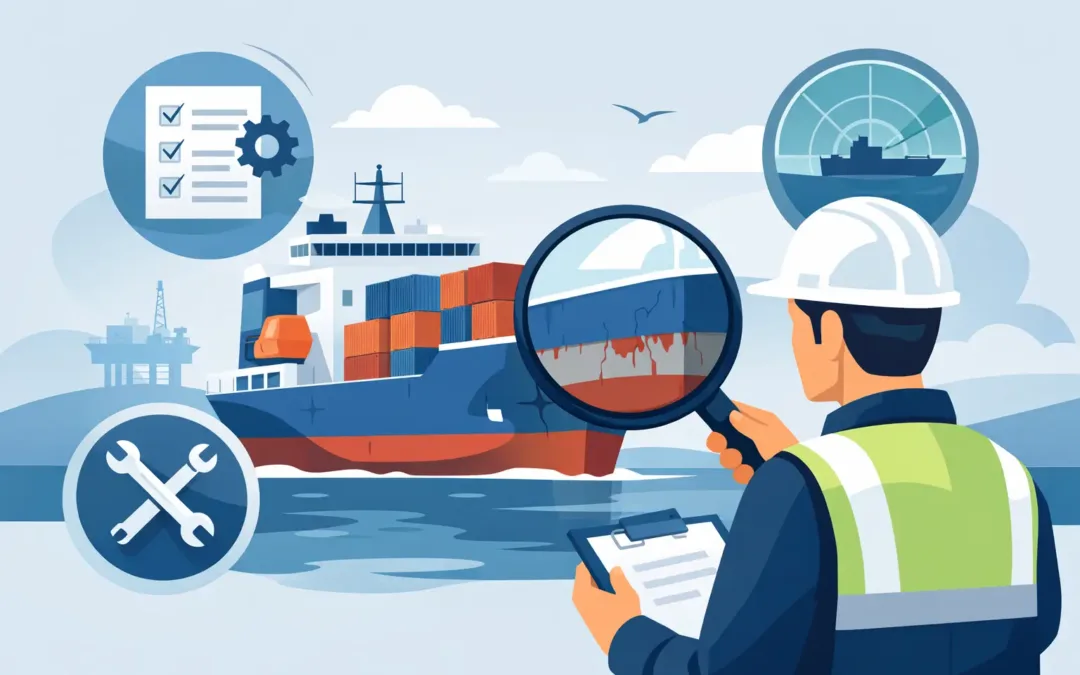
A vessel can remain commercially active while carrying conditions that materially increase P&I exposure: degraded hatch-cover compression, unsafe access routes, poor housekeeping, weak enclosed-space controls, or machinery spaces with unresolved leakage and fire risks. A P&I vessel condition survey provides an independent, evidence-based view of those exposures before they develop into crew injury, cargo damage, pollution, detention, or third-party claims.
For owners, operators, charterers, and P&I interests, the value is not simply a list of deficiencies. The survey establishes what was observed, where it was found, how it affects risk, and what corrective action should be prioritized. That distinction matters when a vessel is changing management, facing an adverse claims record, entering a demanding trade, or responding to a club recommendation.
What a P&I Vessel Condition Survey Is Designed to Assess
A P&I condition survey is a risk-control inspection focused on the vessel conditions most likely to create liability exposure. Its scope is typically broader than a single equipment test and more operationally focused than a class survey. It examines whether the ship is being maintained, operated, and documented in a manner consistent with safe navigation, cargo operations, pollution prevention, crew welfare, and statutory obligations.
The precise scope depends on the vessel type, cargoes, trade route, age, management history, and the requesting party’s concerns. A bulk carrier, for example, may require close review of hatch covers, access arrangements, ballast spaces, cargo hold condition, and loading practices. For a tanker, attention may center on pollution-prevention measures, cargo transfer controls, containment, fire safety, and the integrity of deck machinery and piping systems. Container vessels, offshore support vessels, and general cargo ships present different operational risk profiles.
A well-executed inspection commonly addresses the vessel’s general condition; deck and accommodation safety; hull and weather-tight integrity; cargo spaces and handling arrangements; machinery-space housekeeping; fire-fighting and life-saving appliances; navigation and communications equipment; pollution-prevention systems; documentation; and the practical implementation of the safety management system.
The surveyor should not treat these items as isolated checkboxes. An oil leak beneath poorly maintained machinery insulation, for instance, is not merely a housekeeping issue. It can indicate fire exposure, maintenance weakness, inadequate supervision, and a potential casualty pathway. The report must connect the observation to the operational consequence.
Condition Findings That Commonly Drive P&I Exposure
P&I claims often arise from ordinary defects that were visible well before the incident. Damaged guardrails, corroded ladders, inadequate lighting, blocked escape routes, unsecured equipment, and noncompliant access arrangements can create serious personal-injury exposure. Deficiencies in garbage handling, oily-water controls, sewage systems, spill-response equipment, or recordkeeping can lead to pollution allegations and regulatory intervention.
Cargo-related findings also carry substantial risk. Water ingress pathways, defective hatch-cover sealing arrangements, poor drainage, damaged coamings, unsecured access covers, unsuitable cargo-space preparation, and ineffective lashing arrangements can contribute to cargo damage or shortage disputes. Where cargo condition is central to the exposure, the P&I condition survey may be supplemented by ultrasonic hatch-cover testing, cargo hold inspection, stowage review, or pre-loading survey work.
Crew-management conditions require the same disciplined attention. Expired safety equipment certificates, incomplete drills, inconsistent permit-to-work controls, poor enclosed-space entry procedures, and weak familiarization records may not produce an immediate casualty. They can, however, significantly complicate the defense of a claim after an injury or operational failure.
How the Survey Should Be Performed
A useful survey begins before the surveyor boards the vessel. The assignment should define the purpose of the inspection, the requested areas of attention, the vessel’s trade and cargo profile, relevant incident history, and whether the report will support risk control, underwriting, management review, chartering, or claims handling. Clear instructions prevent a broad survey from becoming a superficial one.
On board, the surveyor should conduct a systematic visual inspection supported by document review, crew discussions where appropriate, and targeted functional checks. The inspection must account for access limitations, weather, cargo operations, vessel schedule, and safe working conditions. A survey performed alongside during an active port call may require a focused approach, while a vessel placed out of service may allow more extensive access and testing.
Photographic evidence should be clear, dated, and tied to a precise location. Findings need enough context to be useful to technical staff who were not present. A photograph of corrosion alone is rarely sufficient. The report should identify the affected structure or equipment, the observed condition, the immediate risk, relevant operational implications, and the recommended corrective measure.
Not every issue has the same urgency. Reports are most effective when findings are ranked by severity and time sensitivity. Conditions presenting an immediate threat to life, pollution prevention, structural integrity, or safe cargo operations should be identified for prompt action. Other deficiencies may be assigned a defined repair or maintenance interval. This prioritization helps operators allocate resources without losing sight of the issues that cannot wait until the next scheduled dry docking.
Independence and Evidence Matter in a Claim Environment
A P&I survey report may later be reviewed by club representatives, insurers, charterers, flag-state officials, legal teams, or claims handlers. Its language must therefore be factual and restrained. The surveyor should distinguish between observed facts, statements made by vessel personnel, available records, and professional opinion.
Terms such as “satisfactory” or “unsatisfactory” have limited value unless supported by objective detail. A defensible report records what was inspected, what could not be inspected, the limitations encountered, and the basis for each recommendation. If a tank was inaccessible, a test was not witnessed, or a certificate was not available at the time of attendance, that limitation should be stated directly.
Independence is equally important. The purpose is not to duplicate the owner’s internal inspection program or produce a report that confirms a preselected outcome. An independent survey provides a clear condition snapshot that management can act upon and that insurers can rely on when evaluating risk. It may identify positive controls as well as deficiencies, but it should never soften material findings for commercial convenience.
When a P&I Condition Inspection Is Most Valuable
The strongest time to arrange a survey is before a loss, not after it. Clubs and operators often request inspections following an unfavorable claims trend, repeated deficiencies, crew-injury concerns, pollution incidents, port-state-control findings, or a change in trading pattern. A pre-charter, pre-purchase, or management-transition inspection can also identify conditions that may affect commercial commitments and liability allocation.
There are situations where a narrow, targeted inspection is more practical than a full condition survey. If the immediate concern is cargo wetting, an ultrasonic hatch-cover survey and cargo-space examination may be the correct response. If the concern is bunker shortage or fuel quality, bunker quantity and quality survey work is more relevant. Where operational systems and safety culture are the central issue, an HSEQ maritime audit may provide deeper analysis than a condition-focused attendance.
The key is to match the assignment to the risk. Broad scope is valuable when the vessel’s overall exposure is uncertain. Targeted scope is better when the claim pathway is already known and rapid evidence is required.
Turning Findings Into Measurable Risk Reduction
A survey has limited value if recommendations are filed without ownership, deadlines, or verification. Vessel management should review the report promptly, assign each action to a responsible person, identify any need for shore-side technical support, and document completion. High-priority deficiencies may require immediate operational restrictions until a safe condition is restored.
Corrective action should address the cause, not just the visible symptom. Replacing a damaged safety sign is appropriate, but repeated missing signage may point to weak onboard inspection routines. Cleaning an oily bilge is necessary, but recurring contamination requires investigation of leakage sources, maintenance planning, and crew reporting practices. This is where a condition survey becomes a management tool rather than a one-time inspection.
Zeus Marine and Cargo Solutions LLC provides independent P&I inspections and vessel-condition survey support for routine risk-control assignments and short-notice matters. For vessels trading through the Gulf Coast or on international assignments, timely attendance and disciplined reporting can preserve evidence while giving management a practical path to closure.
A vessel’s condition is not defined only by its certificates or its last dry-dock date. It is demonstrated by the condition found on board, the controls used every day, and the speed with which known deficiencies are corrected. A properly scoped P&I survey gives decision-makers the evidence needed to act before a manageable defect becomes a costly liability.
